

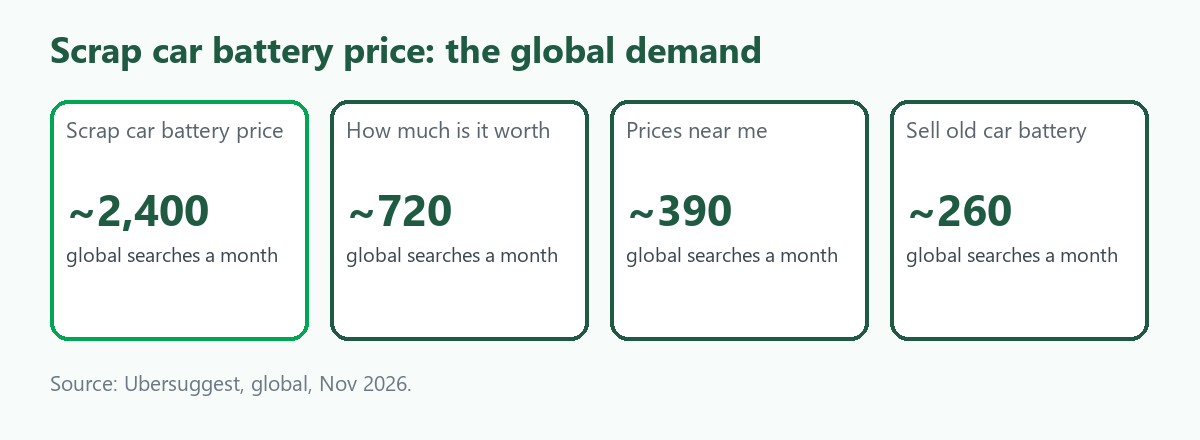
"Scrap car battery price" is searched about 2,400 times a month worldwide, according to Ubersuggest, with "how much is a scrap car battery worth" about 720, "scrap car battery prices near me" about 390, "sell old car battery" about 260 and "where can I sell old car battery" about 320. The cost per click is low, about 1 to 2 dollars, which fits a trade where the value of one battery is small. The searchers have an old battery from a car and want to know whether it is worth anything and where to take it. This guide gives no price, because we found none that was current and independent, and explains what the price depends on, how take-back works and who buys. It belongs to our guide to selling scrap cars, car parts and used tires online, and our Australian companion is Sell an Old Car Battery in Australia. ScrapTrade runs a scrap marketplace and has a commercial interest in the scrap trade.
Why the price is small and moves
A car battery is mostly lead, with plastic casing and acid. Industry sources describe the value as coming from the lead and the plastic, and the lead price moves with the metal market, so a scrap offer moves with it. We found no source for a typical per-battery payout, and published figures are undated buyer pages. A buyer's offer for a single battery is usually a weight-based or flat per-battery figure, and we cannot say which is more common. Ask which it is, and whether the quote holds at the counter.
Take-back and core charges
A waste-industry profile attributes the very high return rate of lead-acid batteries to the ease of returning a used battery when you buy a new one, and to the value of the lead and plastic. Most US states, according to one source, require retailers to take back old lead-acid batteries from customers who buy new ones. That is the mechanism behind a core charge, a deposit added to the price of a new battery and refunded when you return the old one. We did not find the core charge amounts or how they are structured, so we state none, and rules differ by country. If you are buying a new battery, returning the old one to the seller is usually the simplest route, and a scrap buyer is the alternative when you are not buying one.
Who buys old car batteries
- Battery and auto-parts retailers. They often take old batteries, especially when you buy a new one.
- Scrap yards. Many buy batteries by weight or per unit, and accept them with metal.
- Battery collectors and recyclers. They gather used batteries and send them to smelters, as our guide to lead-acid battery recycling explains.
- Garages and dealers. They may take a battery when they fit a new one.
- Trade marketplaces. For lots, as below.
What to check before you sell
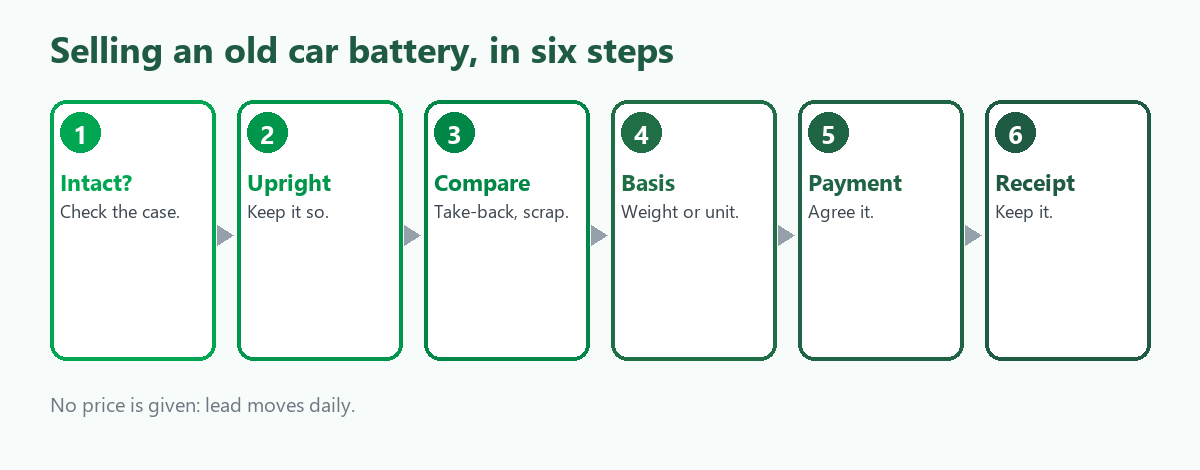
- Is the case intact? A cracked or leaking battery is a hazard, and buyers may refuse it. We did not research handling rules, so ask a recycler before moving a damaged one.
- Keep it upright. A general precaution for batteries containing acid.
- Ask how the offer is set. Weight or per battery, and whether it can change.
- Compare two options. The retailer's take-back and a scrap buyer.
- Agree payment. Cash, credit or refund of a core charge.
- Keep a receipt. It shows the battery was handed to an authorized collector.
When you have more than one
A garage or fleet with a stack of old batteries is a different job. Count the batteries and note the types, keep them upright on pallets or in leak-proof containers, and ask a buyer for a written quote that says whether it is by weight or per unit, who collects, and when payment is made. Ask for a receipt that records the count and the collector's details. We did not research battery transport rules, which are strict in many places, so confirm them with the buyer before anything is moved.
Where ScrapTrade fits
One car battery is a retailer take-back or a trip to a yard, and ScrapTrade is not the route for it. The marketplace suits lots: a garage with a pallet of old batteries, a fleet changing batteries or a collector with a load. Batteries is one of its twelve categories, and verified traders in more than 50 countries bid. Listing is free with no commission, you negotiate in real time and an accepted bid puts the buyer's 5 percent deposit in escrow. Businesses and individuals can sell once verified. How batteries are packed, weighed and shipped on the marketplace is unconfirmed, and battery transport has its own rules, so ask cs@scraptrade.com.au before you plan a shipment.
What we could not verify
- What any battery sells for. We found no reliable current source.
- Core charge amounts and structures.
- Rules on handling and shipping damaged batteries.
- How batteries are packed and shipped through ScrapTrade.
Frequently asked questions
How much is a scrap car battery worth?
It follows the lead price and varies by buyer. We give no figure, because we found no reliable one.
Where can I sell an old car battery?
Battery retailers, scrap yards, collectors and garages. Compare take-back with a scrap offer.
What is a core charge?
A deposit on a new battery refunded when you return the old one, where such schemes apply. We did not find the amounts.
Can I list batteries on ScrapTrade?
Batteries is a category and verified sellers can list. We could not confirm packing and shipping details, so ask support.
Sources
- Ubersuggest keyword data, global, queried November 2026.
- Battery Council International recycling-rate coverage and a Waste360 profile of lead-acid batteries, as summarised in search results.
- ScrapTrade website, accessed November 2026.
General information only, not safety or legal advice. Take-back rules differ by place.