

If you sell scrap in India you will see the same metal priced three ways: per kilogram, per quintal and per tonne. They are the same price in different units, and getting them confused is an easy way to be shortchanged. This guide gives you the conversion, then a way to turn a world metal price into rupees, then a way to check any dealer's offer against it. It uses the London Metal Exchange (LME) prices and the rupee rate of 2 to 3 November 2026, and it does not give you a yard price, because nobody can without knowing your grade, quantity and location. We have a commercial interest in the scrap trade.
Kilogram, quintal and tonne
| Unit | Weight | If the rate is ₹100 a kg |
|---|---|---|
| Kilogram | 1 kg | ₹100 |
| Quintal | 100 kg | ₹10,000 |
| Tonne (metric tonne, MT) | 1,000 kg | ₹1,00,000 (one lakh) |
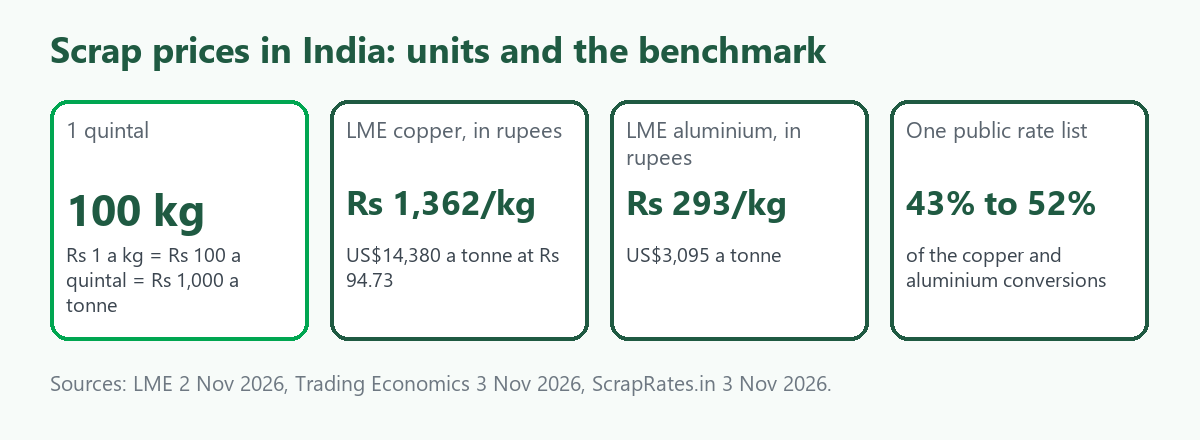
So ₹1 a kilogram is ₹100 a quintal and ₹1,000 a tonne. Households and small collectors are usually quoted per kilogram, and larger lots more often per tonne, and some price lists use quintals. We did not find a source on which unit is most common. Whatever the unit, always ask for the rate "per kg" in the end and multiply by the weight on the scale. A rate of ₹39 a kilogram and a rate of ₹39,000 a tonne are the same.
Note that the world price is quoted per tonne in US dollars. A US dollar price of US$14,380 a tonne is not US$14,380 a kilogram, and not ₹14,380 either. The next section does the conversion.
From a world price to a rupee price
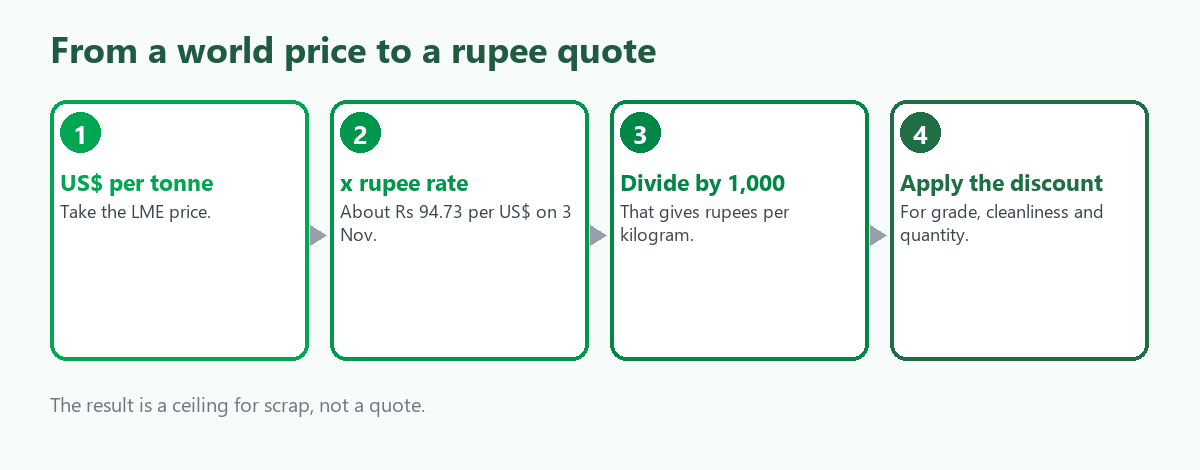
The formula is short:
Rupees per kilogram = (US dollars per tonne × rupees per US dollar) ÷ 1,000
On 2 November 2026 LME cash settlement prices were as shown below, and the rupee was about ₹94.73 to the US dollar on 3 November, according to Trading Economics. The rupee has lost about 6.75% against the dollar over a year but gained about 1.65% in the past month.
| Metal | LME cash, US$ a tonne | ₹ per kg | ₹ per quintal | ₹ per tonne |
|---|---|---|---|---|
| Copper | 14,380 | ₹1,362 | ₹1,36,216 | ₹13,62,156 |
| Aluminium | 3,095 | ₹293 | ₹29,318 | ₹2,93,176 |
| Zinc | 3,935 | ₹373 | ₹37,275 | ₹3,72,746 |
| Lead | 1,870 | ₹177 | ₹17,709 | ₹1,77,090 |
| Nickel | 15,260 | ₹1,446 | ₹1,44,551 | ₹14,45,514 |
| Tin | 49,520 | ₹4,691 | ₹4,69,082 | ₹46,90,817 |
These are prices for refined metal. They are a ceiling for scrap, not a quote. Scrap sells at a discount that depends on grade, how clean it is, quantity, location and who is buying. Steel and iron scrap have no LME price, so use a local reference: an iron rate of ₹39.12 a kilogram, for example, equals about US$413 a tonne at the current rate.
How far is an offer from the benchmark?
The useful number is the ratio: offer ÷ benchmark. To see what that looks like in practice we looked at one public rate list, ScrapRates.in for Chandigarh, dated 3 November 2026. It lists copper at ₹581.42 a kilogram, aluminium at ₹152.75, iron at ₹39.12, brass at ₹423.34 and stainless steel at ₹135.52. It says the rates come from 28 or more buyers, are indicative, and are updated daily. It does not state grades.
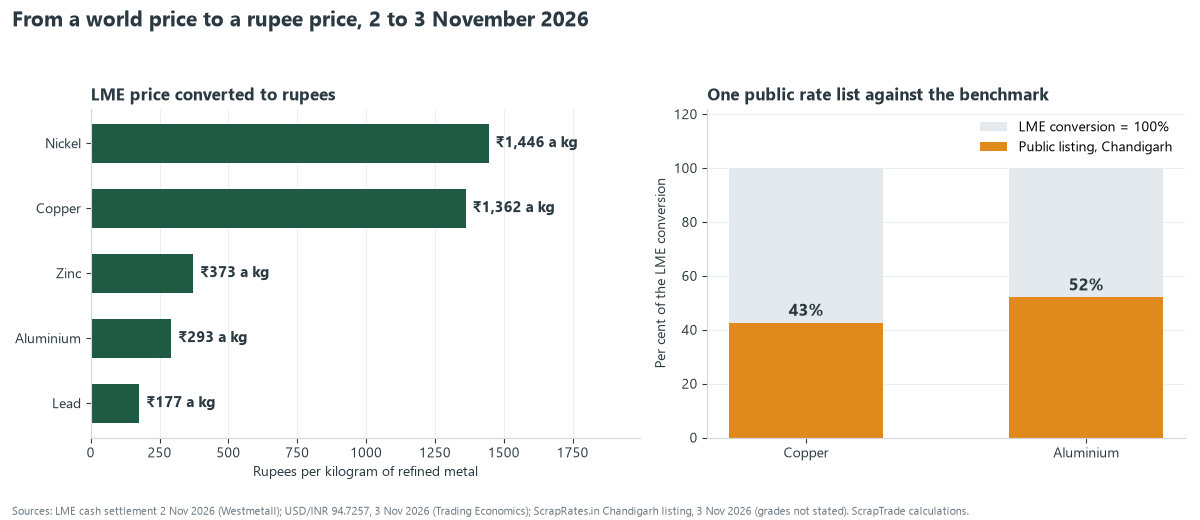
Against the table above, the copper listing is 43% of the LME conversion and the aluminium listing is 52%. That does not show that anyone is paying too little. LME copper is refined cathode and the listing is unspecified scrap, and small lots are bought at a bigger discount than a truckload. But a gap that size tells you three questions to ask any dealer before you agree:
- Which grade is this rate for? "Copper" can mean clean wire, mixed or motor scrap, and they differ.
- What date and what deductions? Ask whether the rate is before or after deductions for dirt, insulation or moisture.
- What is the rate for a bigger or cleaner lot? The first quote for a small lot is rarely the best one.
An invented example. You have 200 kg of clean copper wire and a dealer offers ₹620 a kilogram, or ₹1,24,000 in all. The LME conversion for 200 kg is about ₹2,72,000, so the offer is about 46% of it. Is that fair? It depends on the grade and on what other dealers offer. Get two more quotes, and ask what the same dealer would pay for 2 tonnes.
When the rupee moves
World metals are priced in dollars, so the rupee changes what the same metal is worth at home. At ₹90 to the dollar the copper conversion is ₹1,294 a kilogram, at ₹94.73 it is ₹1,362, and at ₹99.50 it is ₹1,431. Aluminium moves from ₹279 to ₹293 to ₹308 across the same range. A weaker rupee raises the rupee price of metal even when the dollar price is flat, and a stronger one lowers it. Trading Economics ties the recent rupee moves to central bank action and to oil prices, which are themselves moving with the US-Iran talks. We explain how that reaches scrap in our guide on how war, oil and inflation move scrap prices.
India and Australian scrap
India is one of the main buyers of Australian scrap. In 2025-26 Australia sent India 423,489 tonnes of metal scrap, 13.9% of its exports, according to government export records (provisional). That was down from 24.0% in 2023-24, when India took 729,789 tonnes. By metal, India took 114,657 tonnes of Australian aluminium scrap, 30.4% of the total, 17,269 tonnes of copper, 15.2%, and 290,192 tonnes of ferrous scrap, 11.4%. India also took 43,177 tonnes of aluminium cans, 42% of all can exports. For the quarter-to-quarter picture, see Australia Scrap Export Tracker: June Qtr 2026, and for the can trade, Australia's Aluminium Can Exports Halved. If you are buying from Australia, read Buying Scrap From Australia: A Buyer's Guide. These are declared export values at the border, not prices.
A note on tax
GST applies to scrap in India, and some metal scrap supplied by unregistered sellers to registered buyers has been brought under reverse charge, where the buyer accounts for the GST, according to trade and tax commentary we saw. Other tax collection rules, such as tax collected at source on scrap sales, also exist, and the sources we saw disagreed on the thresholds. We have not checked the notifications and cannot advise. Ask a chartered accountant what applies to your sales.
Check the numbers yourself
- Convert the world price. Use the formula above, and our guide to converting metal prices to your currency per kg.
- Try the calculator. The ScrapTrade India calculator estimates a value in rupees by grade, quantity and unit. Its prices are, by its own description, AI-generated indicative estimates, not locked-in trading prices, so check them against the benchmark.
- Compare more than one buyer. Browse the marketplace, or create a free account to list your scrap and see what buyers offer.
Rupee and unit terms are explained alongside a multilingual glossary: Scrap Glossary in 7 Languages: 22 Key Terms.
Buying Australian copper or aluminium? See: Buying Copper and Aluminium Scrap in Australia.
What we could not verify
- Yard prices in India. We publish none, and the LME conversion is for refined metal.
- The method behind the public rate list. It does not state grades or sources beyond "28+ verified buyers".
- How common each unit is. We found no source on how often quintals are used for scrap.
- Indian tax rules. We have not checked the GST notifications or the collection thresholds.
- Today's prices. LME and rupee figures are from 2 and 3 November 2026 and will have moved.
Frequently asked questions
How do I convert a scrap price from per quintal to per kg?
Divide by 100. A rate of ₹6,000 a quintal is ₹60 a kilogram. To go from per tonne to per kg, divide by 1,000.
How do I convert a US dollar price per tonne into rupees per kg?
Multiply by the rupee rate and divide by 1,000. At ₹94.73 to the dollar, US$3,095 a tonne is about ₹293 a kilogram.
Why is the scrap rate lower than the LME price in rupees?
The LME price is for refined metal. Scrap is sold at a discount for grade, contamination, quantity and location.
What is a lakh?
A lakh is 1,00,000 (one hundred thousand), so ₹13,62,156 is about 13.6 lakh rupees.
Sources
- London Metal Exchange official prices, 2 November 2026, as published by Westmetall.
- Trading Economics, USD/INR, 3 November 2026. Indicative market data.
- ScrapRates.in, Chandigarh scrap rates, updated 3 November 2026. Indicative rates, grades not stated.
- Department of Climate Change, Energy, the Environment and Water, Waste exports data collation, September 2026 (ABS records), ScrapTrade calculations. The 2025-26 figures are provisional.
- ScrapTrade, India scrap price calculator page and its stated disclaimers.
The example is invented. This is general information, not financial, tax or legal advice. Prices change daily. ScrapTrade operates a scrap marketplace and has a commercial interest in the scrap trade.