

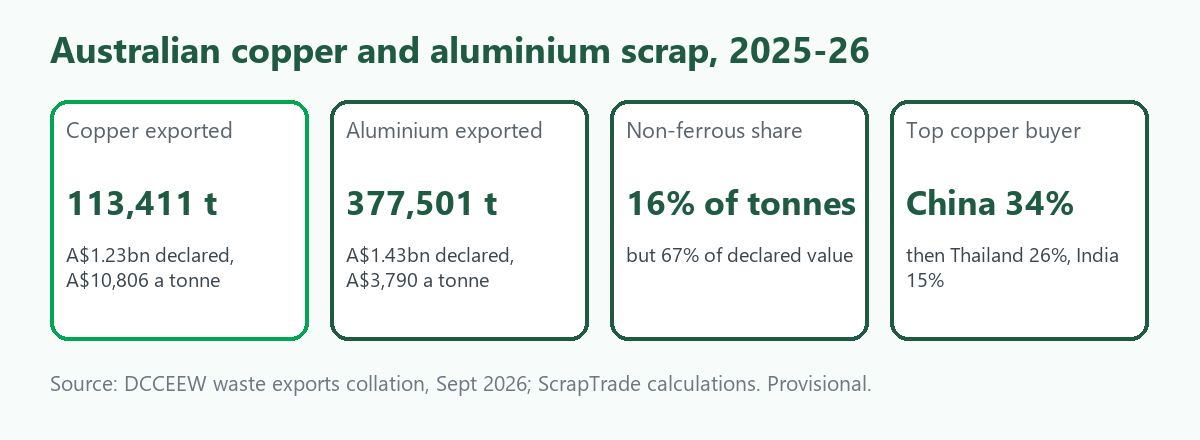
Copper and aluminium are the part of Australia's scrap trade that overseas buyers should look at first. Non-ferrous metals were only 16 percent of Australian scrap exports by weight in 2025-26, but 67 percent by declared value, A$3.05 billion of A$4.58 billion, according to government export records. This guide is for buyers outside Australia who want to source copper and aluminium scrap from Australian sellers. It sets out how much there is, which lines it comes in, where it ships from, who else is buying it, and what to check before you agree a deal. It builds on our general Buying Scrap From Australia: A Buyer's Guide, and ScrapTrade has a commercial interest in the scrap trade.
How much there is
In 2025-26 Australia exported 113,411 tonnes of copper scrap, with a declared value of A$1.23 billion, and 377,501 tonnes of aluminium scrap, with a declared value of A$1.43 billion. The 2025-26 figures are provisional, and we exclude one March 2025 aluminium record of 92,400 tonnes that is almost certainly a recording error, as explained in Reading Australia's Scrap Export Data Properly.
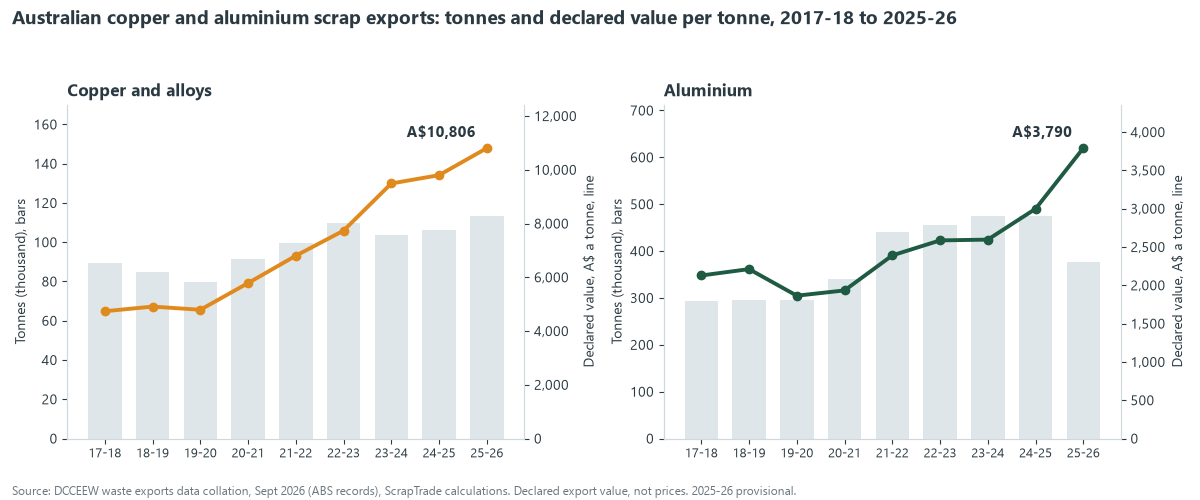
Copper tonnes have grown by about a quarter since 2017-18 (89,409 to 113,411), and declared value per tonne has more than doubled, from A$4,737 to A$10,806. Aluminium tonnes rose from 293,110 in 2017-18 to 475,084 in 2023-24, then fell 20 percent in 2025-26, while declared value per tonne rose from A$2,128 to A$3,790. If you plan to buy aluminium, note that part of the fall and the price rise comes from the beverage-can line, which halved in a year. See Australia's Aluminium Can Exports Halved. These are declared border values, not prices.
What the customs lines mean
Government export data splits each metal into customs lines. They do not match trade grades, and a line can hold a wide range of material.
| Line (2025-26) | Tonnes | Share of the metal | Declared value per tonne |
|---|---|---|---|
| Copper alloys, excluding brass | 77,109 | 68% | A$12,243 |
| Refined copper waste | 22,885 | 20% | A$5,236 |
| Brass | 13,418 | 12% | A$12,049 |
| Aluminium waste, excluding cans | 275,352 | 73% | A$4,059 |
| Aluminium beverage cans | 102,150 | 27% | A$3,065 |
So when a seller quotes "copper", ask which of these it is and, more usefully, which trade grade. The line tells you the category, not the quality. We explain the common grades in Scrap Metal Types and Grades and Aluminium Cans (UBC) Scrap.
Where it comes from
Copper is spread across the east and west coasts: New South Wales 27.5 percent of 2025-26 tonnes, Victoria 26.9, Queensland 22.1, Western Australia 14.9 and South Australia 8.5. By port, Sydney loaded 29.1 percent, Melbourne 26.1, Brisbane 21.0 and Fremantle 15.2. Aluminium is more concentrated in Victoria, at 39.8 percent, then Queensland 23.4 and New South Wales 21.6, and Melbourne loaded 29.5 percent, Brisbane 27.2 and Sydney 25.6. If you are choosing where to find sellers, that is where the material is. See Australian Scrap Export Ports: Who Ships What for how the ports compare.
Who else is buying
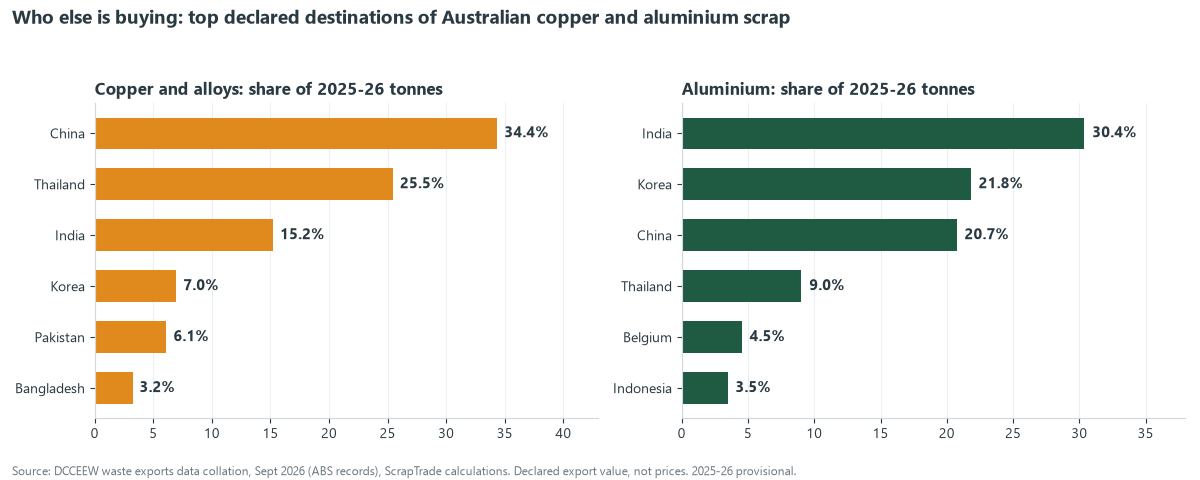
You will be competing with established buyers. In 2025-26, China took 34.4 percent of Australian copper tonnes, Thailand 25.5 and India 15.2, with South Korea at 7.0 and Pakistan at 6.1. For aluminium, India took 30.4 percent, South Korea 21.8 and China 20.7, then Thailand at 9.0, Belgium at 4.5 and Indonesia at 3.5. These are declared destinations at export, not where the metal is finally used. For the quarter-to-quarter picture, see Australia Scrap Export Tracker: June Qtr 2026.
Parcel sizes
A record in the export data is one month, one origin, one port, one destination and one customs line. It is not one shipment, and a record can hold several containers. Even so, the sizes show how each metal trades. The median copper record was 49 tonnes, 68 percent were under 100 tonnes, and the largest was 1,250 tonnes. The median aluminium record was 100 tonnes, and records over 500 tonnes made up 58 percent of aluminium tonnes. Copper is traded in smaller parcels and aluminium in larger ones. If you want a regular supply of copper, expect to work with several sellers.
How to price an offer
The export values above are not prices. To judge an offer, start from the world reference and then ask what discount the seller applies for grade, cleanliness and quantity. Convert the London Metal Exchange (LME) price into your currency with Convert Metal Prices to Your Currency per Kg, and compare it with our Australian benchmark prices in A$ per kg. The ratio of the offer to the benchmark is the number to compare across sellers. We show how in Scrap Metal Prices in India. Freight and the exchange rate move the delivered cost too, and we cover them in War, Oil and Inflation: What Moves Scrap Prices.
Five checks before you commit
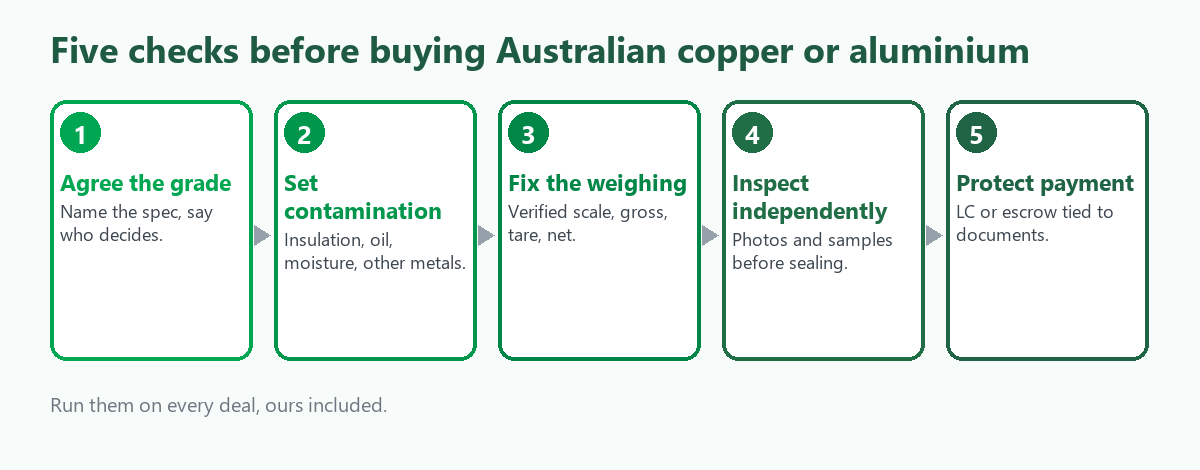
- Agree the grade in writing. Name the specification, such as an ISRI or ReMA grade, or a written description, and say who decides at the gate. A grade that is not defined is the most common source of disputes.
- Set contamination limits. For copper, state limits on insulation, oil, solder and other metals. For aluminium and cans, state limits on moisture, dirt, plastics and other metals, and the form, baled or loose.
- Fix how the weight is set. Ask where the load is weighed and whether the scale is verified for trade. The National Measurement Institute says weighbridges used for trade must be of an approved type and verified by a servicing licensee.
- Arrange independent inspection. Consider a pre-shipment inspection by a third party, with photos and samples, before the container is sealed.
- Protect payment. Use a method that matches the risk, such as a letter of credit or escrow, and tie release to documents or inspection. See How to Agree Terms With an Original Seller and Incoterms in Scrap Deals.
Australia's rules on exporting waste, and which materials they cover, are set out in Australia's Waste Export Rules and Scrap Metal. Check what your own country requires on import.
Where ScrapTrade fits
ScrapTrade is a global online marketplace for scrap metal and recyclables. It does not buy, store or move material. Sellers can list at a fixed price, by auction or in answer to a buyer's request, and its Trust & Safety page says the buyer pays a 5% deposit of the agreed value, held in escrow through Stripe and released to the seller when the buyer confirms receipt or after a 24-hour window passes without a dispute. Escrow protects the payment, not the physical condition of the material. It does not guarantee any price or grade, so run the five checks above on any deal, ours included. Browse the marketplace or create a free account to post what you want to buy.
What we could not verify
- Yard prices and offers. We publish none, and export values are not prices.
- Which sellers have stock now. The export data shows past flows, not current supply.
- Quality by line. The customs lines do not show grade or contamination.
- Import rules in your country, which you need to check.
- Whether 2025-26 figures will be revised. They are provisional.
Frequently asked questions
How much copper scrap does Australia export?
In 2025-26, 113,411 tonnes with a declared value of A$1.23 billion (provisional), mostly copper alloys, about 12 percent of it brass.
Which countries buy Australian copper and aluminium scrap?
China, Thailand and India take most of the copper. India, South Korea and China take most of the aluminium.
Is the declared value per tonne the price I will pay?
No. It is a border declaration for mixed shipments. Start from the LME price and ask the seller for the discount.
Where in Australia is the scrap?
Copper comes mainly from New South Wales, Victoria and Queensland, and aluminium mainly from Victoria, Queensland and New South Wales.
Sources
- Department of Climate Change, Energy, the Environment and Water, Waste exports data collation, September 2026 (ABS records), ScrapTrade calculations. Metals category, 2017-18 to 2025-26. The 2025-26 figures are provisional.
- National Measurement Institute, Weighbridges used for trade (Department of Industry, Science and Resources).
This is general information, not financial or legal advice. Declared export values are border declarations for mixed shipments, not prices. ScrapTrade operates a scrap marketplace and has a commercial interest in the scrap trade.