

Most scrap problems cost money. A few cost far more. A sealed gas bottle in a pile of steel can explode in a shredder. A discarded measuring device with a radioactive source can contaminate a whole yard. A lithium battery in a bag of e-waste can start a fire that nobody can see coming. These are not everyday risks, which is exactly why new traders ignore them, and why one bad load can end a business or injure someone.
This guide covers the items to refuse, what the regulators and safety bodies say about each, what to do if you find one and how to write a refusal policy you can actually follow. The scenarios are invented. We also say where we could not find Australian-specific guidance and have relied on regulators elsewhere. It is general information, not safety or legal advice, and it adds depth to the short safety section in How to Verify Scrap Before You Buy or Sell.
The short list
| Item | Why it is dangerous | Default rule |
|---|---|---|
| Gas cylinders, tanks, sealed drums and containers | Can hold pressurised, flammable or toxic gas, and burst when cut or crushed | Do not buy or accept intact ones |
| Anything with a radiation warning, gauges and old industrial instruments | May contain a radioactive source | Do not touch. Report |
| Lithium-ion batteries | Can ignite when damaged or crushed | Remove and keep separate |
| Oil, fuel and fluids | Leak, burn, contaminate the load | Drain or refuse; no dripping loads |
| Material from hazardous processes | May carry hazardous residue | Ask for proof it is treated |
1. Gas cylinders, tanks and closed containers
What the safety bodies say. Washington State's Department of Labor and Industries put it plainly in a hazard alert for scrap yards: intact metal tanks and cylinders usually contain pressurised, flammable or toxic gases, and if you puncture, cut or crush them they can violently depressurise or explode, start fires or release toxins [1]. Its advice is to make it a policy not to accept or alter intact tanks and cylinders, because without specialised equipment and training you cannot tell whether they are safe or what they contain. Staff should assume every intact tank is not empty, and should not try to remove a valve or puncture one. A tank counts as depressurised when its valve has been removed and a large hole made in the body, and even then it can hold toxic residue [1].
Dubai Municipality's guideline for scrap traders takes the same line. Scrap must not contain pressurised, closed or insufficiently open containers that could cause explosions in a furnace [2].
Where they hide. The alert warns that intact cylinders may already be mixed into incoming scrap, for example attached to vehicles. They also turn up in workshop clear-outs, demolition sites and old appliances [1].
Scenario: the bottle in the pile
Tom is clearing a closed-down workshop for a client, and the metal pile includes a small gas bottle with its valve still on. He is tempted to load it with the rest, since it is steel and the yard pays by weight. He instead sets it aside, tells the client it needs to go back to its supplier or a qualified contractor, and leaves it behind. That costs him a few minutes. The alternative is a bang in a shredder, a closed yard and a supplier who never calls again. (Invented example.)
2. Radioactive sources
What the regulators say. The United States Environmental Protection Agency warns that if radioactive material is improperly disposed of, it can contaminate and shut down an entire facility, and that cleaning up can easily cost more than a million dollars. Melting radioactive sources with ordinary scrap can create metal that is itself radioactive. Items are usually small, and the problem can also come from piping from oil and gas, water treatment or mining that is contaminated with technically enhanced naturally occurring radioactive material [3]. New Zealand's Ministry of Health describes the same problem and advises scrap yards to use portal monitors at the gate [4].
What the EPA tells everyone to do. If you think you have found contaminated scrap, do not touch it, immediately contact the yard manager and your state radiation office, and limit exposure by time, distance and shielding: spend as little time near it as you can, stay as far away as you can and put something heavy and thick between you and it [3].
For a small trader. You are unlikely to own a monitor. You can still refuse anything with a radiation warning, be wary of old gauges, instruments and industrial equipment of unknown origin and ask your buyer how they screen loads. If you export to India, note that India requires a pre-shipment inspection certificate stating that scrap was checked for radiation, and containers without it can be sent back. See India's Scrap Market: Imports, Duties, Rules.
Scenario: the heavy old gauge
A demolition crew lifts a small, very heavy metal device with a faded yellow-and-black symbol. It looks like brass or lead. A worker suggests adding it to the copper pile. Their supervisor stops everyone, moves people back, tells the site manager and calls the state radiation authority. The device is collected by specialists, and nobody is blamed for the lost scrap value. (Invented example.)
3. Lithium-ion batteries
Lithium-ion batteries are in e-bikes, scooters, power tools, laptops and phones, and they are a leading fire cause in waste and recycling. Waste360, reporting on Australian figures, said authorities and fire services attributed more than 1,000 fires across Australia to lithium-ion batteries in 2023, and an industry executive said recycling facilities and trucks were catching fire [5].
We could not find an Australian regulator's guidance written specifically for scrap yards, so what follows is our practical suggestion, not a quotation from an authority.
- Take batteries out before you buy or sell mixed e-waste, appliances and tools.
- Never crush, bale or shred a lot that might contain them.
- Store them separately, away from piles of other material, and ask a battery recycler where to send them.
- Tell your buyer if a lot may contain batteries.
- Treat swollen, hot or damaged batteries as urgent.
Scenario: the bag of e-waste
Mia buys a bag of old electronics for A$150, planning to strip the copper and aluminium. At the bottom is an e-bike battery pack, slightly swollen. She puts it in a metal bucket of sand outside, away from the shed, and arranges a battery recycler pick-up. Her next lot she inspects before she pays. (Invented example.)
4. Oil, fuel and other fluids
Engines, gearboxes, compressors and transformers can all hold oil. Dubai Municipality's guideline says oil, oily emulsions, lubricants or grease should not be visible in any part of a scrap load, apart from negligible amounts that will not drip, and tells traders to look especially at the bottom of the load [2]. Drain what can be drained and refuse what cannot. Never mix a leaking item into clean metal. Check what local environmental rules say about disposing of the fluids.
5. Material from hazardous processes
Scrap that came from hazardous processes, or was in contact with hazardous waste, can carry contamination you cannot see. The same Dubai guideline says no hazardous waste should have been used as input to obtain scrap unless there is proof it was treated in an approved process, and says the requirement should be written into the contract with the waste generator [2]. Ask where the material came from and ask for paperwork if it came from an industrial site.
What to do if you find something
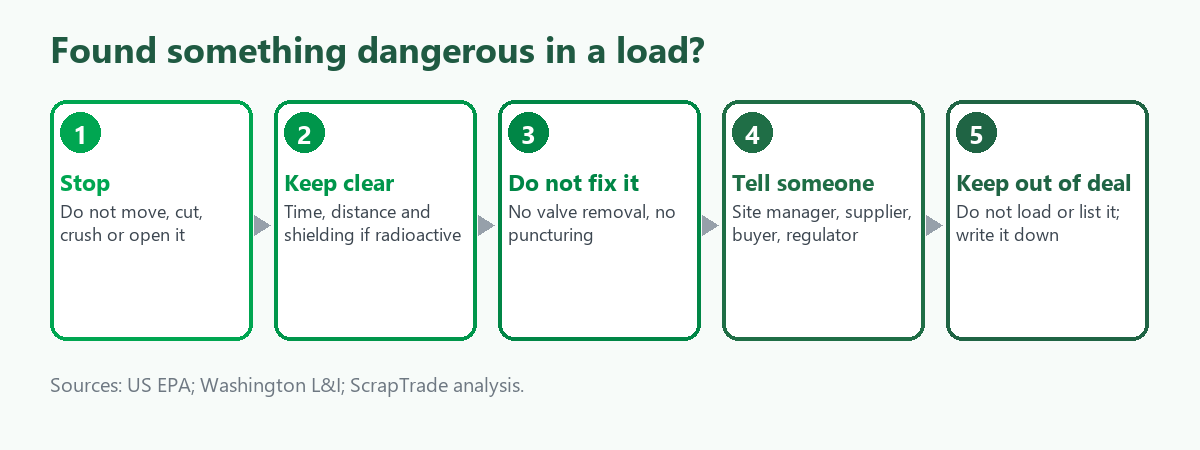
- Stop. Do not move, cut, crush or open it.
- Keep people away, especially if it could be radioactive. Use time, distance and shielding [3].
- Do not try to fix it. Do not remove a valve or puncture a cylinder [1].
- Tell the right person: the site manager, the supplier, your buyer and, for radiation, the radiation regulator [3].
- Keep it out of the deal. Do not load it or list it. If it has already shipped, tell the buyer at once.
- Write it down. Date, item, where it was found, who was told and what was done.
A refusal policy you can use
Write it, keep it on your phone and share it with anyone who helps you.
| Rule | Wording |
|---|---|
| Containers | "We do not accept sealed or pressurised containers, gas cylinders, drums or tanks." |
| Radiation | "We do not handle anything carrying a radiation warning. We stop and report." |
| Batteries | "Batteries are removed before purchase. Mixed e-waste is inspected." |
| Fluids | "Loads must not drip. Fluids are drained first." |
| Unknown origin | "Industrial equipment of unknown origin needs documentation." |
| Authority to stop | "Anyone can stop a load, and nobody is blamed." |
On a marketplace
If you sell through a platform, say in the listing what is and is not in the lot, such as "no sealed containers, batteries removed". ScrapTrade's trust page states that escrow does not protect the physical condition of material once it changes hands, and a buyer can raise a dispute within 24 hours if a load does not match its listing [6][7]. An undisclosed hazard is a quick way to lose that dispute and your reputation. See How to Secure Scrap Deals and Avoid Scams and A Scrap Deal on ScrapTrade: Worked Examples.
What we could not verify
- Australian regulator guidance for yards. We did not find ARPANSA or state environment agency guidance written for scrap yards on radioactive items or batteries. Ask your state radiation regulator and environment agency.
- Other hazards. Asbestos, mercury switches, PCB-containing capacitors, refrigerants and airbags also appear in scrap. We have not researched them here, and the rules differ by place.
- Local law. Handling, storing and transporting hazardous materials is regulated, and penalties vary. This article does not replace advice from a regulator or a qualified adviser.
To start from the rules in your place, see Scrap Business Rules and Documents by Country, Scrap Business Rules in Australia by State and Scrap Business Rules in Dubai: The Guidelines. You can browse the ScrapTrade marketplace or register.
Frequently asked questions
Can I buy gas cylinders as scrap?
Safety bodies advise yards not to accept or alter intact cylinders and tanks, because they can explode when cut or crushed [1]. Refuse them unless a qualified professional has made them safe.
What should I do if I think scrap is radioactive?
Do not touch it. Keep people away, tell the yard manager or site manager and contact your radiation regulator [3].
Are lithium batteries really a fire risk in scrap?
Yes. Waste360 reported authorities attributing more than 1,000 fires in Australia to lithium-ion batteries in 2023 [5].
Can I sell a load with a little oil on it?
Dubai Municipality's guideline allows only negligible amounts that will not drip, and says to check the bottom of the load [2]. Drain what you can.
Who is responsible if a dangerous item is in a load I sold?
It depends on the contract and the law where you are. Disclose what is in the lot, and ask a lawyer about your obligations.
Sources
- Washington State Department of Labor and Industries, Exploding Tanks During Metal Recycling (hazard alert, 18 May 2017).
- Dubai Municipality, Technical Guidelines on Scrap & Metal Waste Trading Activity, version 1.0, 22 August 2024.
- US Environmental Protection Agency, Radioactive Material in Scrap Metal.
- New Zealand Ministry of Health, Radioactive material in scrap metal recycling.
- Waste360, Lithium-ion batteries responsible for more than 1,000 fires across Australia in 2023 (14 March 2024).
- ScrapTrade, Trust and safety, as published in October 2026.
- ScrapTrade, How ScrapTrade works, as published in October 2026.
This article is general information, not safety, legal or financial advice. The people and scenarios are invented. ScrapTrade operates a scrap marketplace and has a commercial interest in the scrap trade.