

Two traders can agree on "US$300 a tonne" and mean prices that are tens of dollars apart. The difference is not the metal. It is the place where the seller's job ends and the buyer's begins: who pays to get the scrap to the port, onto the ship, across the ocean and through customs, and who is carrying the loss if something goes wrong on the way. Trade shorthand for that is an Incoterm, a three-letter code such as FOB or CFR that sits next to the price. This article explains the ones scrap traders meet, with worked examples. The numbers in the examples are invented, and the people in them too. It is general information, not legal advice.
What an Incoterm is, and is not
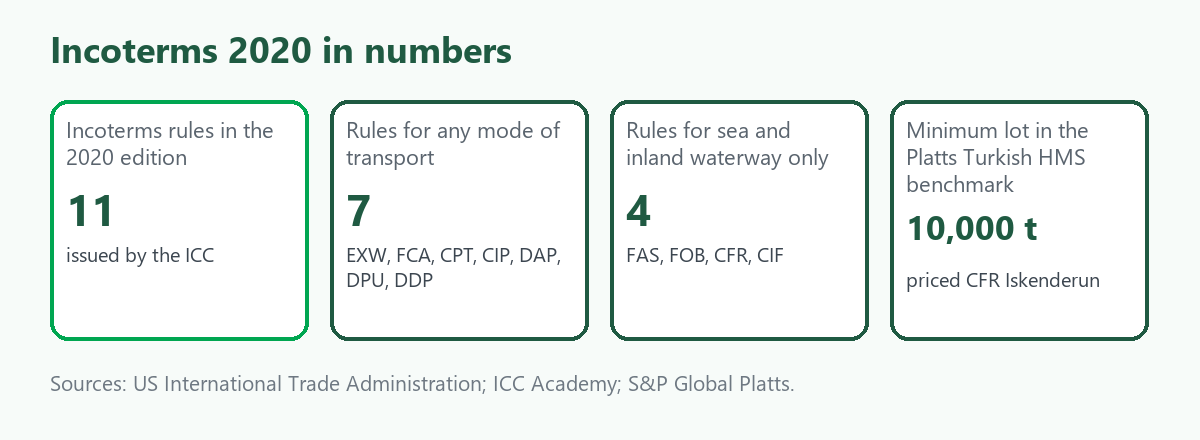
Incoterms are a set of rules issued by the International Chamber of Commerce (ICC) that define the responsibilities of sellers and buyers in international sales [1]. The US International Trade Administration describes the 2020 edition as 11 rules: seven that work for any mode of transport and four for sea and inland waterway only [1]. Each rule sets out who arranges and pays for carriage and insurance, who handles export and import clearance, and where delivery takes place and risk passes from seller to buyer [1].
Just as important is what they leave out. The same source says Incoterms do not address all the conditions of a sale, do not identify the goods or list the price, do not set the method or timing of payment, do not decide when ownership passes, and do not cover liability for late or non-conforming delivery or how disputes are resolved [1]. For scrap, that means the term tells you where risk moves, but not what grade you are getting, how the weight is settled or when you get paid. Those belong in the contract. See How to Negotiate a Scrap Deal and Tonnes, Gross Tons and Short Tons in Scrap.
A contract should also say which edition applies. The International Trade Administration notes that parties may still agree to use an earlier edition such as Incoterms 2010, provided they clearly specify it [1].
The four terms scrap traders meet most
FCA: Free Carrier
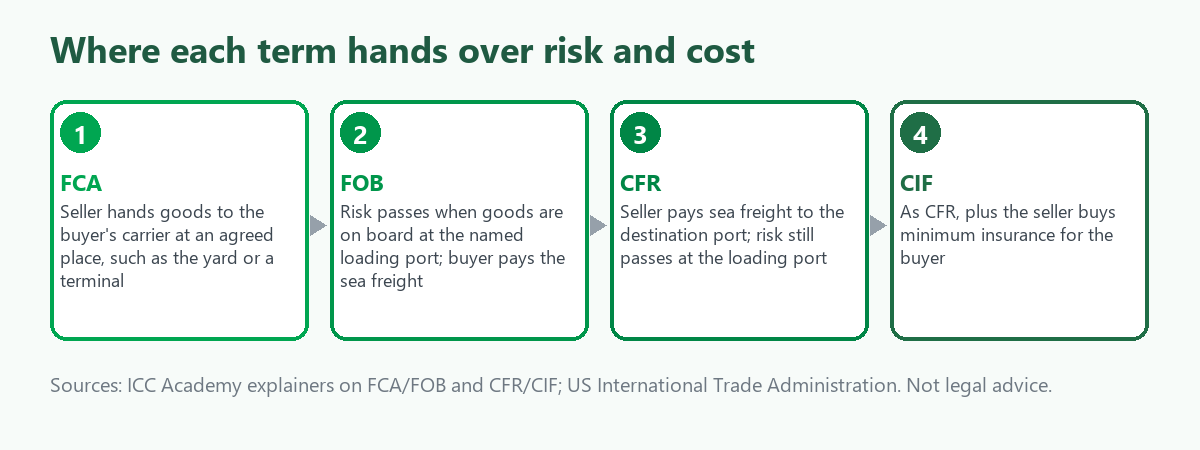
Under FCA the seller delivers the goods to the carrier the buyer has named, at an agreed place. That can be the seller's own premises, where delivery is complete once the goods are loaded onto the buyer's collecting vehicle, or somewhere else such as a container terminal, where the goods are handed over ready for unloading. In both cases the seller is responsible for export clearance, and the buyer takes the risk from the moment of delivery [2]. FCA suits any mode of transport, including multimodal shipments, and an ICC Academy article by an ICC-certified trainer says it is well suited to container transport [2].
FOB: Free on Board
Under FOB the seller delivers, and risk passes, when the goods are loaded on board the vessel at the named port of shipment. The seller completes export formalities. FOB is for sea or inland waterway transport only, and the buyer contracts and pays for the carriage [2]. One detail catches people out: if the goods are ready at the port on time but the buyer fails to give timely notice of the vessel, or the vessel arrives late, the buyer bears all risks and costs from then, even if the goods have not been loaded [2].
CFR: Cost and Freight
CFR works like FOB for risk, but the seller also arranges and pays the sea freight to the named destination port. Risk of loss or damage still passes to the buyer when the goods are on board at the loading port. The seller has no obligation to buy insurance, so the buyer is advised to buy cover. The seller must give the buyer timely notice of loading, and the buyer handles import clearance and duties. The ICC Academy article, written by a lawyer, describes CFR as suitable for bulk or non-containerised goods and raw materials [3].
CIF: Cost, Insurance and Freight
CIF is CFR plus insurance. The seller must contract insurance for the buyer's benefit from the loading port to the destination port. The insurance can be limited cover under Institute Cargo Clauses (C), not the fuller cover of Clauses (A) [3]. If you are the buyer and want broader cover, you either negotiate it or buy it yourself.
Why this matters for scrap prices
The best-known ferrous benchmark makes the point. S&P Global's Platts TSI HMS 1/2 80:20 assessment is labelled "Deep-sea Turkey Imports CFR Iskenderun Port". It reflects bulk ferrous scrap imports into Turkey, covers ISRI codes 200-206, uses a minimum lot of 10,000 tonnes and reflects cargo for delivery three to eight weeks ahead [4]. That price is a delivered-to-port number: it includes the freight.
If you are an exporter in Australia, you do not receive that number. You receive the CFR price minus the sea freight, minus port charges, inland haulage and your own costs, which is a figure sometimes called a netback. Comparing a delivered price to an ex-yard price is a classic way to feel cheated or to over-promise.
Worked example 1: turning a CFR quote into an FOB figure
Hamid in Perth (invented) is offered "US$340 CFR" for a bulk cargo of steel scrap. He asks his shipping agent for freight and is told US$45 a tonne to the destination port.
| Item | US$ per tonne |
|---|---|
| CFR price offered | 340 |
| Less sea freight | 45 |
| Equivalent FOB price | 295 |
He then compares it with a second buyer's "US$300 FOB". The second offer is US$5 a tonne better, even though its headline number is lower. On a 10,000 tonne cargo the gap is US$50,000. (Numbers invented to show the arithmetic. Freight moves constantly and is not a standard figure.)
Worked example 2: who pays when the cargo is damaged at sea
A bulk shipment sold CFR is damaged when a hold floods in rough weather. The risk passed to the buyer when the cargo was on board at the loading port. The seller had no duty to insure under CFR, so the buyer's loss is uninsured unless the buyer bought cover. Under CIF the seller would have bought minimum insurance, so a claim is possible, subject to the limited cover [3]. The lesson for buyers is to insure under CFR. For sellers, check whether your buyer expects CIF.
Worked example 3: the missed vessel
A seller in Brisbane (invented) sells 2,000 tonnes FOB. The goods are on the quay on the agreed date. The buyer's vessel is late and closes to cargo early. Under FOB, a failure by the buyer to give timely notice or a late vessel means the buyer bears the risks and costs even though the goods are not yet on board [2]. If a storm damages the stockpile on the quay, the buyer carries it. The seller should still keep written notices of readiness and dates.
Containers: be careful with FOB
Many scrap shipments go in containers, particularly non-ferrous and mixed loads. The FOB and CFR rules were written for port-to-port ship transport, and the ICC Academy FCA and FOB article describes FOB as for maritime or inland waterway transport and FCA as well suited to container and multimodal transport [2]. In practice, a container is usually handed to a terminal, not placed on board by the seller, and sits there before loading. If your contract says FOB but the real delivery is a hand-over to a terminal, the contract does not match the rule. The simple fix is to name the point of delivery clearly, and consider FCA with a named terminal for containers. See Selling Scrap in Bulk: Container Loads, Minimum Orders and MOQs.
What the term does not settle
- Weight and quality. Say where and when weight is determined (loading port or discharge port), how any difference is handled and who pays for any inspection. The International Trade Administration notes that each rule addresses who bears pre-shipment inspection costs, but the contract must still say what is inspected and what the result decides [1].
- Payment. Incoterms do not set the method or timing of payment [1].
- Ownership. Incoterms do not decide when title passes [1].
- Import rules. Under CFR and CIF the buyer handles import clearance [3], but a seller still needs to know whether the destination will accept the material. See India's Scrap Market and China's Copper and Aluminium Scrap Import Rules.
- Export rules. Seller-side export formalities apply under FCA, FOB, CFR and CIF [2][3]. For Australian sellers, see Australia's Waste Export Rules and Scrap Metal.
A scenario: choosing a term for a first export
Priya runs a small yard in Melbourne (invented) and has a buyer overseas who wants 24 tonnes of mixed aluminium offcuts in one container.
- She asks what the buyer's quote assumes. "US$2,100 delivered" and "US$2,100 FCA our yard" are very different offers.
- She picks a term that matches how the box actually moves. For one container leaving her yard, FCA at her yard or a named terminal fits better than FOB.
- She writes weight and quality rules into the contract. Who weighs, on which scale, with what tolerance.
- She confirms payment first. The term does not cover it.
- She keeps photos and documents from loading, because risk has moved by then.
What this means for you
- Always write the term with a named place: "FCA Melbourne terminal", "CFR Iskenderun". The place is part of the term.
- Compare prices on the same basis before you decide which offer is better. Convert CFR to FOB with a real freight quote.
- Ask which edition applies, and put it in the contract.
- If you are a buyer under CFR, insure the cargo.
- For containers, check whether FCA fits better than FOB.
- Do not rely on the term to settle payment, weight or title. Those clauses need to be written.
On ScrapTrade, the platform says it does not arrange delivery, so parties agree this between themselves. You can compare buyers on the marketplace, or register.
Frequently asked questions
What is the difference between FOB and CFR?
Under both, risk passes when the goods are on board at the loading port. Under FOB the buyer arranges and pays the sea freight. Under CFR the seller pays the freight to the destination port [2][3].
What does CIF add to CFR?
The seller must also contract minimum insurance for the buyer, which can be limited cover under Institute Cargo Clauses (C) [3].
Why are Turkish scrap prices quoted CFR?
The Platts benchmark for imports into Turkey is assessed on a CFR Iskenderun basis, so it includes the freight [4].
Which term should I use for containers?
FOB and CFR are for port-to-port sea transport. An ICC Academy article describes FCA as well suited to container transport [2].
Do Incoterms say who pays and when?
No. They do not set the method or timing of payment, and they do not decide when ownership passes [1].
Sources
- US International Trade Administration, Know Your Incoterms.
- ICC Academy, FCA & FOB Incoterms 2020 explained: Key differences (19 November 2024). The article states its author's views, not ICC policy.
- ICC Academy, CFR & CIF Incoterms 2020 explained: Key differences (21 August 2024), by a guest contributor. The article states its author's views, not ICC policy.
- S&P Global, Turkish Scrap: Platts TSI HMS 1/2 80:20.
The people, prices and freight figures in the examples are invented to show the arithmetic. Incoterms are published by the ICC, and a summary is not the official rule text. This article is general information, not legal advice. ScrapTrade operates a scrap marketplace and has a commercial interest in the scrap trade.