

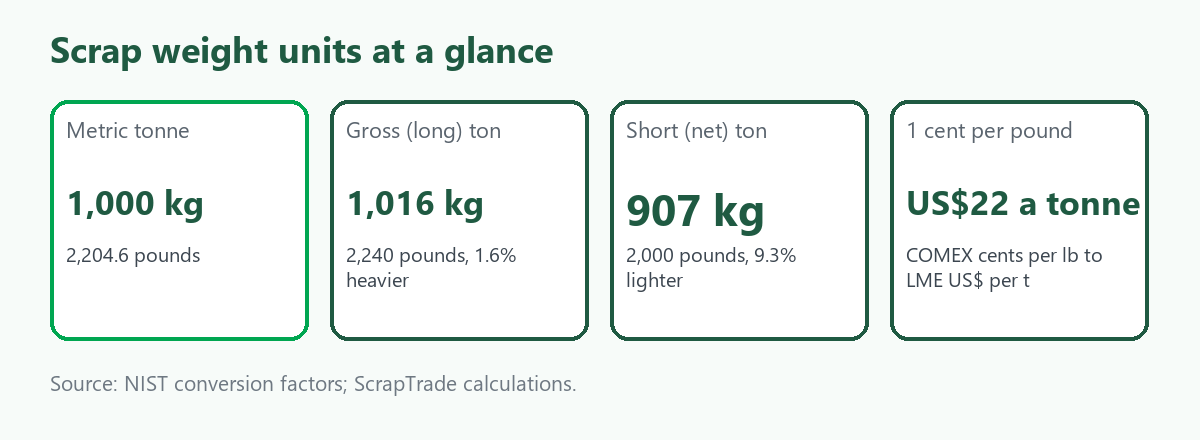
"A ton of steel" sounds like one thing. In the scrap trade it is at least three. The metric tonne used in most of the world weighs 1,000 kilograms. The gross ton, also called the long ton, weighs about 1,016 kilograms. The short ton, also called the net ton, weighs about 907 kilograms. The gap between the biggest and the smallest is 12%. On a 500 tonne cargo that is real money, and the mistake is easy to make because contracts, price reports and weighbridge tickets often just say "ton".
This explainer sets out the units, shows how to convert both weights and prices, untangles "gross weight" from "gross ton" and works through three examples. The people in them are invented. It is general information, not trading advice.
The three tons
| Unit | Also called | Pounds | Kilograms | Where used |
|---|---|---|---|---|
| Metric tonne (t, mt) | tonne | 2,204.62 | 1,000 | Most of the world, including Australia, and the benchmarks in the next section |
| Gross ton | long ton, British ton | 2,240 | 1,016.047 | Some US and UK steel scrap trading |
| Short ton | net ton, US ton | 2,000 | 907.185 | Common in US usage |
Source for the kilogram values: US National Institute of Standards and Technology conversion factors, which list a long ton (2,240 lb) as 1,016.047 kg, a short ton (2,000 lb) as 907.1847 kg and a metric ton as 1,000 kg [1]. Pounds per tonne are our calculation from NIST's pound-to-kilogram factor of 0.4535924.
Two rules of thumb help.
- A gross ton is about 1.6% heavier than a tonne. 100 gross tons is about 101.6 tonnes.
- A short ton is about 9.3% lighter than a tonne. 100 short tons is about 90.7 tonnes.
Who uses which
Practice differs, so check every time rather than assuming.
- Australian export data are in metric tonnes. All the tonnage figures in our export analyses are metric.
- Price reporting agencies commonly quote per metric tonne. S&P Global says the Platts Turkish heavy melting scrap price is published in US dollars per metric tonne [2].
- Some US companies report in gross tons. Steel Dynamics, for example, reports its ferrous scrap shipments in gross tons, as we noted in The Biggest Scrap Recyclers: What Data Shows.
- US usage often means a short ton unless stated otherwise, and some yards are reported to quote prices per hundredweight (100 pounds) rather than per ton.
Not every source agrees about which unit is standard for US steel scrap, and we found no authoritative statement. The safe habit is to ask: "metric tonne, gross ton or short ton?" and write the answer into the agreement.
How to convert weights
| To convert | Multiply by |
|---|---|
| Gross tons to tonnes | 1.016 |
| Short tons to tonnes | 0.9072 |
| Tonnes to gross tons | 0.9842 |
| Tonnes to short tons | 1.1023 |
| Gross tons to short tons | 1.12 |
| Short tons to gross tons | 0.8929 |
| Pounds to kilograms | 0.4536 |
| Kilograms to pounds | 2.2046 |
How to convert prices
A price per unit works the other way round. If a unit is bigger, the same number buys more metal.
| To convert a price | Do this |
|---|---|
| Per gross ton to per tonne | Divide by 1.016 |
| Per short ton to per tonne | Divide by 0.9072 (or multiply by 1.1023) |
| Per tonne to per gross ton | Multiply by 1.016 |
| Per tonne to per short ton | Multiply by 0.9072 |
| Cents per pound to US dollars per tonne | Multiply by 22.046 |
| US dollars per pound to US dollars per tonne | Multiply by 2,204.6 |
| Dollars per kilogram to dollars per tonne | Multiply by 1,000 |
The cents per pound conversion matters for copper, because United States copper prices on COMEX are quoted in cents or dollars per pound, while the London Metal Exchange quotes dollars per tonne. A price of 600 cents per pound is about US$13,228 a tonne. Going the other way, an LME price of US$13,000 a tonne is about US$5.90 a pound.
That also lets you read a trade report. Fastmarkets reported in July 2025 that the gap between COMEX and LME copper had widened to around US$2,500 to US$2,700 a tonne [3]. In US terms that is about 113 to 122 cents a pound, which is why a discount "to COMEX" and a discount "to LME" can differ so much. See How Scrap Prices Are Set: Benchmarks Explained.
Gross weight is not a gross ton
This catches many people. At a weighbridge or on a delivery docket, three words appear.
- Gross weight: the total weight of the truck and its load.
- Tare: the weight of the empty truck.
- Net weight: gross weight minus tare, which is the weight of the material.
"Gross" here means "the whole lot, container and all". It has nothing to do with the gross ton, which is a unit of 2,240 pounds. A docket might say "gross weight 38.2 tonnes, tare 14.7 tonnes, net 23.5 tonnes". You are paid on the net weight, in whichever unit the contract says. If the contract is in gross tons, convert the net weight into gross tons first. In Australia, trade weighbridges must be approved and verified, and public weighbridges are open to anyone for a fee [4]. See How to Verify Scrap Before You Buy or Sell.
Three examples
Example 1: the contract in the wrong unit
Lena in Melbourne agrees to sell 100 tonnes of steel scrap to a buyer. The buyer's contract says "US$300 per ton". Lena assumes tonnes. The buyer means gross tons.
- Lena's 100 tonnes is 98.42 gross tons.
- At US$300 a gross ton the payment is US$29,526.
- At US$300 a tonne it would have been US$30,000.
A difference of US$474, or 1.6%. It is small here because the two units are close, but it is money lost for no reason. If the buyer had meant a short ton, the shortfall would be much bigger: 100 tonnes is 110.23 short tons, which at US$300 would pay US$33,069.
Example 2: the ambiguous invoice
A seller invoices "50 tons" of material worth A$450 a tonne. The buyer pays for 50 short tons, which is 45.36 tonnes. The seller meant 50 gross tons, which is 50.80 tonnes.
| Meaning | Weight in tonnes | Value at A$450 |
|---|---|---|
| 50 short tons | 45.36 | A$20,412 |
| 50 metric tonnes | 50.00 | A$22,500 |
| 50 gross tons | 50.80 | A$22,861 |
The spread is about A$2,450, or 12%, on one word. Writing "50.0 metric tonnes" removes the argument.
Example 3: reading two price quotes
A trader sees two quotes for similar steel scrap.
- Quote A: US$300 per gross ton.
- Quote B: US$305 per tonne.
Convert A to tonnes: US$300 divided by 1.016 is US$295.3 a tonne. So B looks dearer by about US$10 a tonne, 3.3%, even though its headline number is only US$5 higher. The two may not be for the same grade or basis, but at least they are in the same unit.
A checklist for every deal
- Name the unit in writing: metric tonne, gross ton or short ton.
- Say which weight counts, net, at which scale and when.
- Give a tolerance, such as 1 to 2%.
- Write the currency and, where relevant, the basis such as FOB or CFR.
- Convert before you compare.
For deal structure see How to Negotiate a Scrap Deal, and for checking a price against the market, the live material prices, which are in Australian dollars per kilogram and indicative only. You can compare offers on the marketplace or register.
Frequently asked questions
How many pounds are in a ton of scrap?
It depends on the ton. A short ton is 2,000 pounds, a gross (long) ton is 2,240 pounds and a metric tonne is about 2,205 pounds.
Is a gross ton the same as gross weight?
No. A gross ton is a unit of 2,240 pounds. Gross weight is the total weight of a vehicle and its load before subtracting the tare.
How do I convert cents per pound to dollars per tonne?
Multiply by 22.046. For example, 600 cents a pound is about US$13,228 a tonne.
Which ton do scrap buyers mean?
It varies, so ask. Price agencies commonly quote per metric tonne, and some US companies report in gross tons.
How big is the difference between the units?
A gross ton is about 1.6% heavier than a tonne, and a short ton is about 9.3% lighter, so the largest and smallest differ by about 12%.
Sources
- National Institute of Standards and Technology, Guide for the Use of the International System of Units, Appendix B8: Factors for Units Listed Alphabetically.
- S&P Global, Turkish Scrap: Platts TSI HMS 1/2 80:20, which shows the price in US dollars per metric tonne.
- Fastmarkets, US copper scrap markets look to transition to LME vs COMEX (15 July 2025).
- National Measurement Institute, Weighbridges used for trade (Department of Industry, Science and Resources).
The people and examples are invented to show the arithmetic. This article is general information, not trading advice. ScrapTrade operates a scrap marketplace and has a commercial interest in the scrap trade.