


Anyone can make one good scrap deal. What separates a pro is that they make a good one again next week, and the week after, and know why. Pros are rarely cleverer than beginners. They are more consistent. They grade the same way every time, write things down, know their numbers, keep their promises and add to the business in a sensible order. This guide shows what that looks like, with a worked example, three made-up scenarios and a growth path. It is general information, not financial advice, and it closes a series that starts with How to Plan a Scrap Business: 90-Day Roadmap.
What pros do differently
They grade the same way every time
Buyers trust consistency. If your "clean aluminium" is clean every time, a buyer will take it without a long inspection, and may pay a bit more for the certainty. Write down your grades, keep samples of each and train anyone who helps you. See how to grade scrap metal.
They know their numbers
A pro can tell you, for any lot, what it cost, what it sold for and what was left. Not a feeling, a number. The ones that matter most are below.
| Number | What it tells you |
|---|---|
| Margin per tonne after freight and deductions | Whether the business pays for itself |
| Days from paying for material to getting paid | How much cash you need to carry |
| Share of lots rejected or re-graded | How good your grading and sourcing are |
| Weight difference between your scale and the buyer's | Whether you are losing money on weighing |
| Share of volume from your top supplier and top buyer | How exposed you are if one of them goes |
They keep records
Write down every deal: date, supplier, material, weight, price paid, costs, buyer, price received, payment date and any dispute. You need records for tax and for the rules in your place, and they protect you if something turns out to be stolen. They also let you spot patterns, such as which supplier's material is always dirty. See Scrap Business Rules and Documents by Country.
They protect their cash
Cash is what keeps you in business. Pros set a maximum lot size and a loss limit, never put everything into one deal and do not pay in advance to strangers. See How to Secure Scrap Deals and Avoid Scams.
They are boringly reliable
They turn up when they said. They pay on the day. They tell people bad news early. This is how a supplier becomes a source for years and a buyer becomes a friend of the business.
A worked profit example
Here is the sort of arithmetic a pro does on every lot. The numbers are invented.
A trader buys 8 tonnes of sorted aluminium extrusion offcuts from a window business.
| Item | Amount |
|---|---|
| Paid to supplier, 8 t at A$2,300 | A$18,400 |
| Transport and loading | A$600 |
| Weighbridge fees | A$60 |
| Total cost | A$19,060 |
| Sold to a yard at A$2,900 for 8 t | A$23,200 |
| Less 2% deduction for coatings | minus A$464 |
| Net sale | A$22,736 |
| Profit before time and overheads | A$3,676 |
| Profit per tonne | about A$460 |
| Return on cash used | about 19% |
If the same lot was sold three weeks after buying and the trader had borrowed the money, interest and waiting time would eat into that 19%. This is why days to cash matters. It is also why one lot is not a business: the question is whether you can do this every week without a bad lot wiping out the profit. Put a number on a "bad lot", say 10% of the material turns out to be steel, and see what happens to the margin.
Three scenarios
All the people below are invented.
Scenario 1: the trader who stopped growing
Kelvin has a steady supply of steel from two workshops and sells to one yard. For a year he makes a small, reliable income. Then the yard lowers its price and he has nowhere else to go. He has a single-buyer problem. He starts calling other yards and listing larger lots on a marketplace where several buyers can see them, and finds a better price within a month. See How to Negotiate a Scrap Deal.
Lesson: a second buyer is not a luxury. It is leverage.
Scenario 2: the trader who grew too fast
Rosa has a great first quarter and decides to quadruple her volume. She buys three large lots on credit from new suppliers, skips sample checks to save time and one load turns out to be mostly brass fittings, not the copper she thought. The loss wipes out her profit for the quarter.
Lesson: grow volume only as fast as your grading, cash and records can keep up.
Scenario 3: the trader who systemised
Imran keeps a simple spreadsheet of every lot. After six months he sees that one supplier's aluminium always comes in 5% dirtier than the others, and that a particular yard always pays two days later than promised. He renegotiates with the supplier, asks the yard for earlier payment or sells elsewhere. His margin goes up without any extra volume.
Lesson: records pay for themselves.
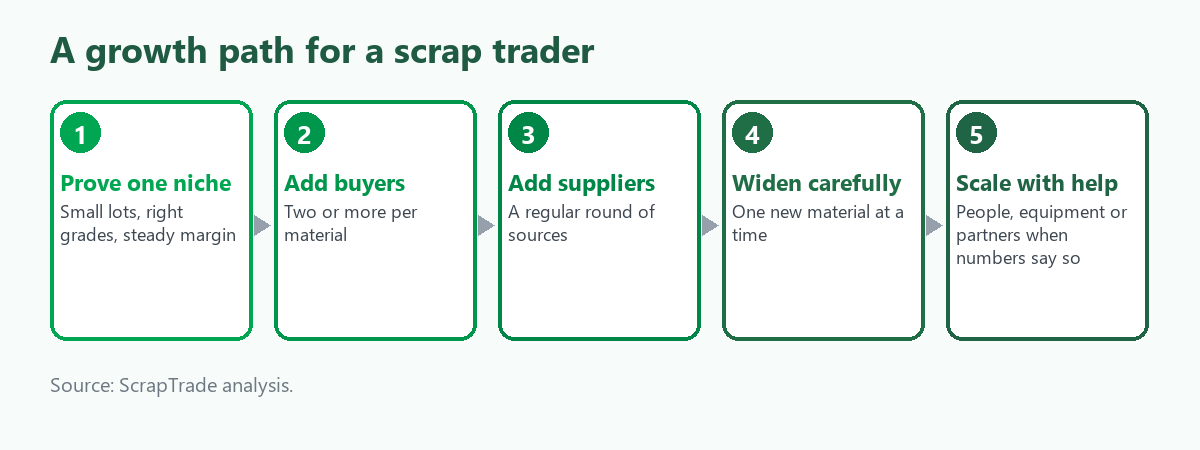
The growth path, in order
Growth in scrap tends to work best in this order. Skipping steps is how people get hurt.
- Prove one niche. Do small lots until your grading is right and you can make a margin consistently. See How to Choose Your Scrap Niche.
- Add buyers. At least two for each material. Compare offers on price, weighing and payment, not just the headline number.
- Add suppliers. Build a regular round of sources. See How to Source Scrap for Your Business.
- Widen carefully. Add an adjacent material, one at a time, and treat it as a new niche with its own learning period.
- Scale with help. Add people, equipment or space, or work through others, only when the numbers say you need to.
See also Side Hustle to Scrap Business: How It Grows and Start Small. Build Connections. Scale Up..
Ways to grow faster without taking big risks
- Use partner recyclers. A yard that knows you will give a faster quote and may take larger lots. See How Partner Recyclers Help You Before a Deal.
- Aggregate. Combine small lots from several suppliers into a size a buyer wants, which often earns a better price.
- Offer a service. Regular pick-up, bins and tidy paperwork make you the easy choice for a supplier.
- Read demand before you buy. The Wanted Board shows what buyers are asking for, in what quantity and grade.
- Work internationally when you are ready. See trading scrap internationally. Rules, documents and risk go up, so do this after you are steady at home.
- Use agents and brokers. If you have supply but not buyers, or the reverse, a scrap agent or broker can help, at a cost. See Become a Scrap Broker or Agent: How to Start.
- Watch the rules. A change in your area can make or break a niche, such as a ban on cash or new record-keeping.
How an online marketplace can help, and where it stops
According to ScrapTrade's pages [1][2], a marketplace like it can help you:
- Reach more buyers with a listing, instead of one or two phone calls.
- Choose how you sell: fixed price, live auction or a response to a buyer's request.
- See demand on the Wanted Board.
- Check a price against the live material prices before you list, remembering they are indicative.
- Get a protected payment step. The buyer's 5% deposit is held in escrow until the buyer confirms receipt or 24 hours pass without a dispute.
- Build a record. The page says businesses can build a visible transaction history.
It cannot grade your scrap, arrange delivery, remove the need to check who you deal with or guarantee condition. The trust page says escrow does not protect the physical condition of the material once it changes hands [2]. Use a marketplace as one channel among several, alongside your own suppliers and buyers. To see a deal move through it, read A Scrap Deal on ScrapTrade: Worked Examples. Browse the marketplace or register.
A pro's weekly routine
| Day | Task |
|---|---|
| Monday | Check prices and buyer needs, plan pick-ups |
| Tuesday to Thursday | Collect, grade, weigh and record |
| Thursday | Sell lots, confirm payment terms in writing |
| Friday | Reconcile the week: costs, sales, rejections, days to cash |
| Once a month | Review margin per tonne, rejection rate and supplier mix, and decide what to change |
Frequently asked questions
How do I become a professional scrap trader?
Choose a niche, grade consistently, keep records, track your margin and days to cash, and build reliable suppliers and at least two buyers per material.
How do I grow a scrap business faster?
Add buyers and suppliers, aggregate lots, offer a reliable service and read what buyers want. Do not grow volume faster than your grading and cash can handle.
What profit margin should I expect?
It depends on the material, freight, grade and how well you buy. Work it out per lot, including costs and deductions, and never rely on an average from someone else's business.
Can a marketplace help me grow?
It can widen your buyer list and give you a protected payment step, but it does not replace your own checks. Check how it works before relying on it.
When should I hire help or buy equipment?
When your numbers show that the extra volume would pay for it, and you have buyers and suppliers to match.
Sources
- ScrapTrade, How ScrapTrade works, as published in October 2026.
- ScrapTrade, Trust and safety, as published in October 2026.
This article is general information, not financial or legal advice. The people, prices and example are invented for illustration. ScrapTrade operates a scrap marketplace and has a commercial interest in the scrap trade.