

When people ask who the biggest scrap companies are, they usually expect a list of recyclers. But the largest users of scrap metal are not scrapyards at all. They are steel mills, which melt it down to make new steel. A mill does not trade scrap in the way a yard or exporter does. It consumes it, tens or hundreds of thousands of tonnes at a time, and it decides what the material is worth by what it can do in the furnace. That makes the mill the real end customer for steel scrap, and understanding it explains most of what yards and exporters ask of sellers. It is general information, not investment advice.
This follows our look at The Biggest Scrap Recyclers: What Data Shows, which noted that many of the world's largest scrap users do not appear on recycler lists.
Two ways to make steel
| Blast furnace and basic oxygen furnace (BF-BOF) | Electric arc furnace (EAF) | |
|---|---|---|
| Main raw material | Iron ore and coking coal, made into pig iron | Mostly scrap steel, sometimes with pig iron or direct reduced iron |
| How much scrap | A minority: the World Steel Association's figure is up to about 30% in a BOF | Up to 100% |
| Energy | Coal | Electricity |
| Typical emissions | 2.32 kg of CO2 per kg of crude steel (WSA, 2024 average) | 0.7 kg per kg for scrap-based EAF (WSA average) |
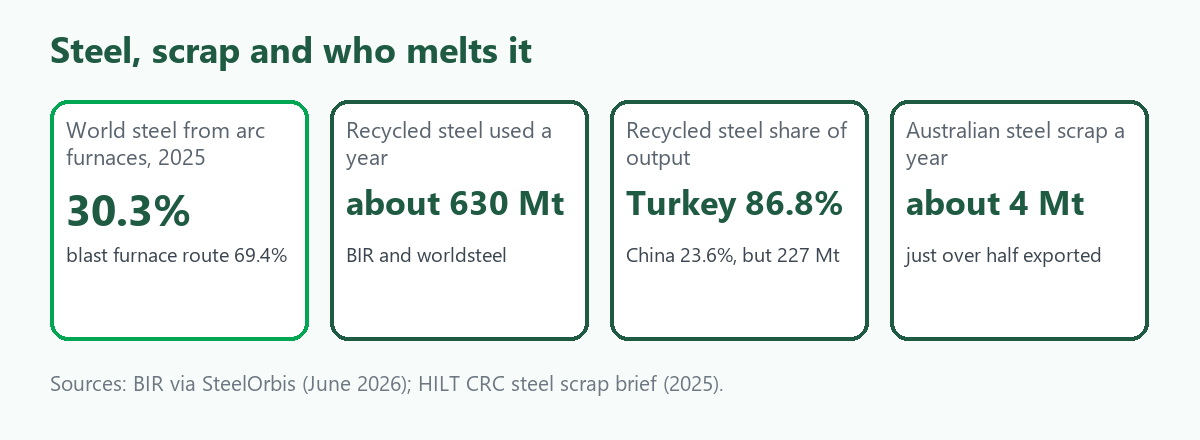
| Share of world steel, 2025 | 69.4% | 30.3% |
Sources: HILT CRC steel scrap policy brief, citing the World Steel Association [1]; BIR via SteelOrbis, citing worldsteel [2].
Both routes can use scrap, but an electric arc furnace is built around it. That is why countries with more EAF capacity consume more scrap and why growth in arc furnaces is what drives scrap demand.
How big is the demand?
The Bureau of International Recycling and worldsteel calculate that about 630 million tonnes of recycled steel is used in steelmaking each year worldwide [2]. For comparison, the whole of Australia's metal scrap exports in 2025-26 were about 3 million tonnes.
The reliance on scrap differs sharply by country, according to BIR's 2025 figures [2].
| Recycled steel as a share of crude steel | Note | |
|---|---|---|
| Turkey | 86.8% | Largely arc furnaces, and the world's largest scrap importer at 18.8 million tonnes in 2025 |
| China | 23.6% | Mostly blast furnaces, but the biggest scrap user in tonnes, at 227 million |
Two things follow. Turkey is a market defined by scrap, which is why its import price is the world's main benchmark, as explained in How Scrap Prices Are Set. And China, with a low share, still uses more scrap than any other country, simply because it makes so much steel.
Why mills do not trade like yards
A mill's business is making steel to a specification. Scrap is a raw material it buys, and it has three characteristics that shape how it buys.
Mills buy in volume, to a grade. They want regular deliveries of a defined grade, such as heavy melting scrap or shredded scrap, delivered to the gate. They buy through dealers and processors, or through their own recycling subsidiaries. Steel Dynamics, for example, reported that about 65% of the ferrous metal its recycling arm shipped in 2025 went to its own mills [3]. Nucor owns a scrap business too, The David J. Joseph Company. For a seller this means the first buyer of your scrap is often a yard or processor, and the last buyer is a mill.
Mills are sensitive to contamination. Unwanted elements in scrap end up in the steel. In an arc furnace they cannot easily be removed, while in a basic oxygen furnace some can be removed as slag [1]. The elements that worry mills include copper, nickel, tin and molybdenum, known as tramp elements. That is why a pile of steel with copper wire still attached is worth less than clean steel, and why mills care about how scrap was collected and sorted.
Mills test what arrives. They weigh, inspect and, where they can, screen loads. Safety is part of this. New Zealand's health regulator notes that radioactive sources that have fallen out of regulatory control have ended up in steel made from scrap, and advises yards to use portal monitors [4]. A load that fails inspection can be rejected, which is why verifying scrap before it moves matters.
Australia's position
Australian steelmaking has a lower scrap share than many countries, which is a big part of why Australia exports so much scrap. A 2025 policy brief by the HILT CRC found the following [1].
- Australia recovers about 4 million tonnes of steel scrap a year, and Victoria and New South Wales together contribute about 63% of it.
- Just over half is exported, with Bangladesh, Vietnam and Indonesia the top three destinations. The brief says this reflects low domestic demand, because only a small share of Australian steel is made in arc furnaces from scrap: about 12% to 17% between 2013 and 2022.
- Domestic scrap use is growing. It doubled from 1.1 million tonnes in 2013 to 2.3 million tonnes in 2022, driven by more EAF production.
- About 40% of Australian scrap is high quality (low in tramp elements), and about 60% is lower quality because much of it comes from end-of-life products.
- The brief estimates that keeping exports onshore could provide enough scrap to more than double EAF steel output, from about 1.43 million tonnes a year to around 3 million tonnes, although it warns that impurities would build up without careful management.
On the mill side, InfraBuild says it runs two electric arc furnaces, at Laverton in Victoria and Rooty Hill in New South Wales, and in a November 2022 release it said it had recovered about 1.4 million tonnes of recycled metals in the past year across 26 scrap recycling sites [5]. We could not confirm more recent tonnages. We also found several announced or proposed new arc furnace projects in Australia, but have not verified their details, so we do not list them here.
The numbers show the choice for an Australian seller. Most scrap ends up at a mill overseas because the domestic demand is small. That could change if more furnaces are built, and a rise in local demand would give sellers another buyer closer to home. Until then, our export data shows where the tonnes go, including the three big buyers compared in Bangladesh vs Indonesia vs Vietnam for Scrap.
What this means for sellers
Scenario: two lots of the same steel
Two yards each sell 100 tonnes of steel to the same mill. Yard A has sorted its material and removed copper wire and motors. Yard B has not. The mill grades both on arrival. A's load passes at the agreed grade. B's is downgraded and the mill deducts for the copper and unwanted material. Same steel, different value, because the furnace cannot tolerate what B left in. (Invented example.)
Practical points
- Think about the end user. Your buyer is probably selling to a mill that has a specification. What the mill rejects, your buyer will reject, and what your buyer rejects, they will deduct from you.
- Clean beats big. Removing copper, motors and non-ferrous attachments from steel raises its quality for arc furnaces. See how to grade scrap metal.
- Mills' own supply chains matter. A mill that owns a recycler buys from itself first, so independent sellers are the margin supply. That affects how they price.
- Follow the furnaces. New arc furnace capacity creates new demand. Closures remove it.
- Know where your material goes. Ask your buyer which mills take it.
For prices see Steel Scrap: HMS and Shredded, and for how to sell, the marketplace and register.
Frequently asked questions
Who is the biggest buyer of scrap metal?
Steel mills. BIR and worldsteel estimate about 630 million tonnes of recycled steel is used in steelmaking each year, and China alone uses about 227 million tonnes [2].
What is the difference between a blast furnace and an electric arc furnace?
A blast furnace makes iron from ore and coal and can take a minority of scrap. An electric arc furnace melts mostly scrap using electricity and can take up to 100% [1].
Why does Australia export so much steel scrap?
Because only a small share of Australian steel is made in arc furnaces from scrap, so domestic demand is limited. Just over half of the roughly 4 million tonnes recovered a year is exported [1].
What is a tramp element?
An unwanted element in scrap, such as copper, nickel, tin or molybdenum, that ends up in the steel and is hard to remove in an arc furnace [1].
Do steel mills sell scrap?
Mostly not. They consume it, though some own recycling companies that trade scrap.
Sources
- HILT CRC, Steel scrap as a strategic commodity for green steel: circularity and analysis of tramp elements accumulation (policy brief, RP3.005), citing the World Steel Association.
- SteelOrbis, BIR: Global recycled steel consumption rises despite lower crude steel output in 2025 (3 June 2026), reporting BIR's World Steel Recycling in Figures.
- Steel Dynamics, Form 10-K for fiscal 2025.
- New Zealand Ministry of Health, Radioactive material in scrap metal recycling.
- InfraBuild, Steel: infinitely recyclable (7 November 2022).
Figures are as reported by the sources named. The scenario is invented. This article is general information, not investment advice. ScrapTrade operates a scrap marketplace and has a commercial interest in the scrap trade.