

In international scrap trade the cargo is the easy part to describe. Grade, weight and price can all go in a contract. The hard part is the gap in time: someone has to trust someone else with money or metal first. The US International Trade Administration puts it bluntly. For an exporter, any sale is a gift until payment is received, and for an importer, any payment is a donation until the goods arrive [1]. Every payment method is a way of deciding who carries that gap. This article walks through the five standard methods, shows where letters of credit fall over, and covers the fraud that bypasses all of them. The people and numbers in the examples are invented. It is general information, not legal or financial advice.
The five methods, from safest to riskiest for the seller
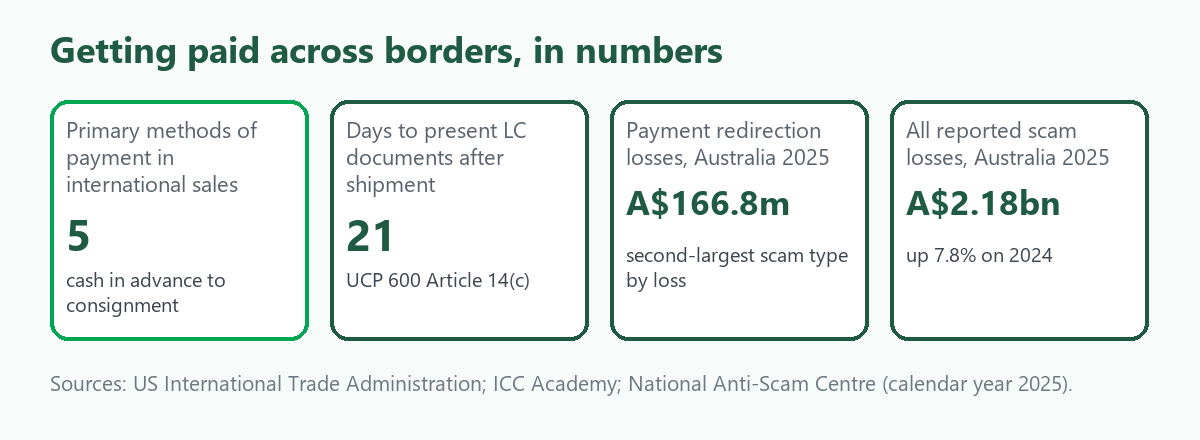
The ITA's Trade Finance Guide lists five primary methods of payment in international transactions [1]. The order below follows the Guide's own descriptions: it calls cash in advance zero risk of non-payment, letters of credit one of the most secure instruments available, open account one of the highest-risk options for an exporter, and consignment very risky [1]. The Guide's figure ranking them was not in the text we could read, so the order is our reading of those descriptions.
| Method | How it works | What the seller carries |
|---|---|---|
| Cash in advance | Buyer pays before the goods are sent, usually by wire transfer | Nothing on credit risk. The risk is losing the sale |
| Letter of credit | A bank commits to pay if the seller presents the documents the credit requires | Bank risk, and the risk that the documents will not comply |
| Documentary collection | Banks pass the shipping documents to the buyer in exchange for payment or a promise to pay | Buyer risk. The Guide says there is no verification process and limited recourse if the buyer does not pay |
| Open account | Goods ship first and payment falls due later, typically in 30, 60 or 90 days | Nearly all of the risk |
| Consignment | Payment arrives only after the goods are sold on to the end customer | All of it, and the goods are in someone else's hands |
The Guide also notes that foreign buyers often press for open account terms, because credit from the seller is more common abroad, and that an exporter who insists on payment in advance may lose the sale to a competitor who offers something better [1]. That trade-off is the whole negotiation. A buyer who has never dealt with you will not want to pay for 500 tonnes of steel they have not seen, and you will not want to ship it on a promise.
For scrap, a few points follow.
- The goods are commodities and the margins can be thin, so a single unpaid cargo can erase many good ones. That is a reason to be conservative with open account.
- Disagreement over weight and grade is common. The payment method decides what happens when the buyer says the cargo is not what was agreed. See How to Negotiate a Scrap Deal and Tonnes, Gross Tons and Short Tons in Scrap.
- The delivery term shapes the payment. Who pays freight and where risk passes both affect when you can safely release documents. See Incoterms in Scrap Deals.
Letters of credit: strong, but strict
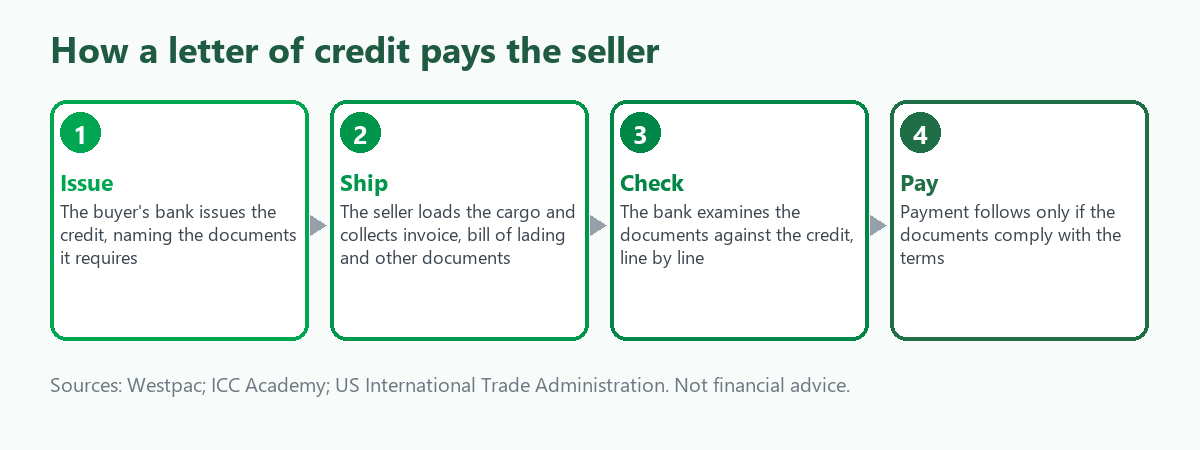
The ITA describes a letter of credit (LC) as a commitment by a bank, on behalf of the buyer, that payment will be made to the exporter provided the LC's terms are met, as shown by presenting all the required documents. It is useful when reliable credit information on a foreign buyer is hard to get but the seller is satisfied with the buyer's bank [1]. Westpac, which offers export LCs in Australia, adds the practical points. A credit is issued as irrevocable, so it cannot be amended or cancelled without the agreement of all parties. It can be payable at sight (immediate payment on presentation) or on a term, such as 30 days after sight. The documents involve items such as a commercial invoice, bill of lading and certificate of origin [2].
Two things an LC does not do automatically
It does not remove the issuing bank's risk or the country's risk. Westpac says this risk can be reduced by having a bank add its confirmation, effectively adding its own guarantee, subject to availability [2]. An unconfirmed credit from a bank in a country with foreign-currency shortages is a different thing from a confirmed one. Ask what you are holding.
It does not pay on a cargo that is merely good. Westpac is explicit that the guarantee of payment relies on presenting documents in strict compliance with the terms of the credit [2]. The bank examines paper, not metal.
Why documents get rejected
An article for the ICC Academy by Xavier Fornt, a member of the ICC Banking Commission (21 April 2026), lists the usual causes of discrepancies [3]:
- Errors in the invoice's currency, unit price, total or goods description, including small spelling or number mistakes.
- Transport documents with missing signatures, wrong shipment dates, unauthorised carriers or wrong ports.
- Insurance cover that is too low, in the wrong currency, or missing endorsements.
- Documents that disagree with each other, for example on the beneficiary's name, the description or the quantity.
- Extra conditions in the credit's "additional conditions" field (47A in the SWIFT message), which are easy to miss.
- Presenting late. Under UCP 600 Article 14(c), documents must be presented within 21 calendar days after shipment and before the credit expires.
- Documents corrected by hand. The article advises reissuing a document rather than correcting it, because a correction can count as an alteration [3].
The article does not quote a discrepancy rate, only that a significant number of presentations contain discrepancies [3]. Some secondary sources we found put it at 60% or 70%, but they conflict and we could not trace the figure to a primary source, so we do not rely on it.
The ICC's advice on avoiding trouble is just as practical. Agree the required documents, their contents and who issues them before the credit is issued, and avoid vague terms. Check every condition when the credit arrives [3]. The time to find that you cannot produce a document is before you accept the credit, not after you have loaded the ship.
Worked example: a credit that cannot be met
Sandeep (invented) agrees to sell 500 tonnes of shredded steel to a buyer overseas. The credit arrives asking for a certificate of origin and an inspection certificate signed by a named inspection company, and describes the goods in a way that differs slightly from his contract. He has two options. He can ask the buyer to amend the credit now, which needs the agreement of all parties [2]. Or he can load and hope his paperwork matches. If the invoice says "shredded scrap" and the credit says something else, the bank can refuse the documents. The metal was right and the paper was wrong, and he is now an unsecured creditor with a cargo in a foreign port. An early phone call costs less than a rejected presentation.
Documentary collections: cheaper and weaker
In a documentary collection the exporter gives the documents to its bank, which forwards them to the buyer's bank with instructions to release them against payment (at sight) or against acceptance of a draft due on a set date [1]. The Guide says these are generally cheaper than LCs but give no verification process and limited recourse if the buyer does not pay [1]. In practice that means the control is the documents. If the buyer must pay to get them, you keep the goods under your control until payment. The risk is what you do with a cargo that is already at the destination port if they refuse. That is a real problem with bulk scrap.
Advance payment, and where escrow fits
Cash in advance has zero credit risk for the seller [1]. The ITA notes that escrow services are becoming another cash-in-advance option for small export transactions [1]. Protected holding of funds can bridge the trust gap between two parties who have never met: the buyer pays, the money is held, and release depends on delivery. The limits matter, though. An escrow protects the payment step. It cannot tell you whether 40 tonnes of mixed aluminium match the description. We cover how ScrapTrade's own escrow works, and what it does not guarantee, in How to Secure Scrap Deals and Avoid Scams.
Open account and credit insurance
The Guide says an exporter offering open account can seek extra protection with export credit insurance [1]. We looked for a short-term Australian product aimed at small exporters. Export Finance Australia's small-business offers that we found were loans, guarantees and bonds, and its payments insurance is for periods over two years, so it may not fit a scrap cargo. Private trade credit insurers and brokers are the other place to ask, and we did not review them. Check what your own broker will cover before you offer terms.
The scam that goes around every method
All of the methods above assume you are paying or being paid by who you think you are. Payment redirection fraud attacks that assumption. Scamwatch describes it as scammers posing as a business you use and sending an invoice with new payee details, so a legitimate payment goes to the scammer instead [4]. Its warning signs are a supplier whose payment details change without notice, and an email address or website with a spelling error or a slight difference. Its advice is to stop and check any change to payee information, contact the business by phone using a number you have sourced independently, and look for an extra letter or number in the email address [4].
The National Anti-Scam Centre's report for 2025 puts payment redirection scams second among scam types by reported loss in Australia, at A$166.8 million, behind investment scams at A$837.7 million. Total reported scam losses were A$2.18 billion, and the figures combine reports to Scamwatch, ReportCyber and several other bodies [5]. These are all scam victims, not only businesses, and we have no scrap-specific breakdown. Even so, an invoice with new bank details is the oldest trick in the book and it works.
Two rules cover almost all of it:
- A bank detail change is not complete until someone has phoned a number you already had. Replying to the email that announced the change does not count.
- Hold the first payment to any changed account until it is confirmed, and have a second person approve changes.
Fake buyers and non-existent cargoes
The other family of fraud invents the counterparty. In 2013 the Bureau of International Recycling (BIR) warned of offers of non-existent scrap cargoes at reduced prices, backed by documents that turned out not to be authentic after checks through the ICC International Maritime Bureau. Offers were often made in the names of real traders whose identities were cloned, sometimes with a lookalike website, and a tempted buyer could be given shipping documents and a tracking link. The BIR noted that once funds are handed over there is little a recycler can do to recover them, and that many cases involve sums too small to be a police priority [6]. In 2020 the Institute of Scrap Recycling Industries (ISRI) reported nearly a dozen companies had shipped scrap aluminium wheels to a fraudulent entity posing as a division of a real manufacturer, with combined value above US$3 million. ISRI said victims did not check the banking and payment information they were given [7].
Both of these are old reports, and we do not know how common the schemes are now. They show the pattern: a trusted name, a deal that looks ordinary, and nobody checking.
A scenario: a first export on mixed terms
Tom runs a metal yard in Newcastle (invented) and has an offer from an overseas buyer for 3 containers of mixed non-ferrous. He has never met them.
- He checks the company exists and speaks to someone he finds himself, not only through the number in the email. See How to Verify Scrap Before You Buy or Sell.
- He asks for payment before the goods leave his control. If the buyer refuses, he asks for a letter of credit, and asks his bank whether it can be confirmed.
- He reads the credit line by line against what he can actually produce, and has anything impossible amended before loading.
- He keeps invoice, packing list and bill of lading consistent, and presents inside the deadline.
- He confirms bank details by phone and treats any last-minute change as a red flag.
- He keeps the weighbridge tickets and loading photos. If payment hinges on a disputed weight, that evidence is what he has.
What we could not confirm
- What terms are normal for scrap exports. We found no authoritative source on typical payment splits in scrap, only commercial blogs, so we do not quote any.
- A reliable discrepancy rate for LCs. Sources conflict.
- An Australian short-term credit insurance product for small scrap exporters. We did not review private insurers.
- Whether a specific bank will confirm a credit from a specific country. That is a bank decision. Ask yours.
- Scrap-specific fraud losses in Australia. The national figures cover all payment redirection, not one industry.
What this means for you
- Decide who carries the risk before you ship, not after. Match the method to how well you know the buyer.
- Treat an LC as a document test. Check what it asks for before you accept it.
- Ask about confirmation if you do not know the issuing bank or its country.
- Verify bank detail changes by phone, every time.
- Do not rely on any payment method to settle disputes about grade or weight. Those must be in the contract.
On ScrapTrade you can compare buyers on the marketplace or register. Payment terms for cross-border deals are agreed between the parties, and your bank should advise on the instrument.
Frequently asked questions
What is the safest way to be paid for scrap exports?
Cash in advance carries no credit risk for the seller, and the ITA calls letters of credit one of the most secure instruments available. In practice the buyer's willingness to accept a method decides what you can use [1].
What is a confirmed letter of credit?
One where a bank adds its own guarantee to the credit, which can reduce the issuing bank's risk and the country risk. Availability depends on the bank [2].
Why do banks reject letter of credit documents?
Usually because of small mismatches: descriptions, amounts, dates, signatures, or documents that disagree with each other [3].
Is a documentary collection safe?
It is cheaper than an LC, but the ITA says it offers no verification process and limited recourse if the buyer does not pay [1].
How do I avoid payment redirection fraud?
Phone the supplier on a number you already hold before paying to any new account, and check the email address for small changes [4].
Sources
- US International Trade Administration, Trade Finance Guide, Methods of Payment.
- Westpac, Export Documentary Letter of Credit.
- Xavier Fornt (ICC Banking Commission member), ICC Academy, ISBP insights: avoiding common LC discrepancies (21 April 2026). The article states its author's views.
- Scamwatch, Business email compromise scams.
- National Anti-Scam Centre, Continued action critical to combat fraud as annual scam losses exceed $2 billion (30 March 2026).
- Recycling Today, BIR Expresses Concern over Fraudulent Deals (22 January 2013).
- Recycling Today, Aluminum wheel shipments targeted in fraud scheme (28 June 2020).
The people, cargoes and terms in the examples are invented. Fraud statistics are as reported by the bodies named. This article is general information, not legal or financial advice. ScrapTrade operates a scrap marketplace and has a commercial interest in the scrap trade.