

Updated 26 October 2026. Recycling is often described as one industry, but it is really a set of very different businesses. Steel and paper recycling are mature, giant and profitable at scale. Aluminium and copper recycling are driven by energy savings and a premium on verified low-carbon metal. Battery recycling is young, capital-hungry and going through a shake-out. Plastics recycling is being squeezed by cheap new plastic, while textiles recycling is barely beginning. This report goes material by material: how much gets recycled, what recyclers actually make from it, how customers are responding, which innovations are real, and which companies are worth watching.
Every figure is attributed to a named source. The sources use different definitions, regions and years, so the numbers are not directly comparable, and where reports conflict or could not be verified we say so. This is an industry overview, not investment advice.
The league table: how much is recycled
| Material | Latest figure | Source |
|---|---|---|
| Steel | About 630 million tonnes of scrap used in world steelmaking. Electric arc furnaces, which melt scrap, made 30.3% of crude steel in 2025, up from 29.1% | EUWID, GMK Center [1][2] |
| Aluminium | More than 30 million tonnes of scrap recycled worldwide each year. Estimates of recycled aluminium's share of supply range from about 28% to 35% | IAI data cited by the Australian Aluminium Council, AL Circle [3][4] |
| Copper | Secondary copper was about 16.9% of world refined output in 2023 | ICSG, via Recycling Today [5] |
| Paper | EU recycling rate 75.1% for all paper products in 2024, and 83.1% for paper packaging | European Paper Recycling Council [6] |
| Glass | EU collection-for-recycling rate 82.2% for glass packaging in 2024 (80.8% in 2023). FEVE estimates 85% of what is collected is recycled in a closed loop | FEVE [7] |
| E-waste | 62 million tonnes generated in 2022, of which 22.3% was formally collected and recycled | UN Global E-waste Monitor 2024 [8] |
| Plastics | About 9% of plastic waste recycled worldwide in 2019. Recycled-content plastic was about 6% of production | OECD [9] |
| Textiles | Under 1% of the textile market is recycled fibre-to-fibre, according to the CEO of recycler Syre | FashionUnited [10] |
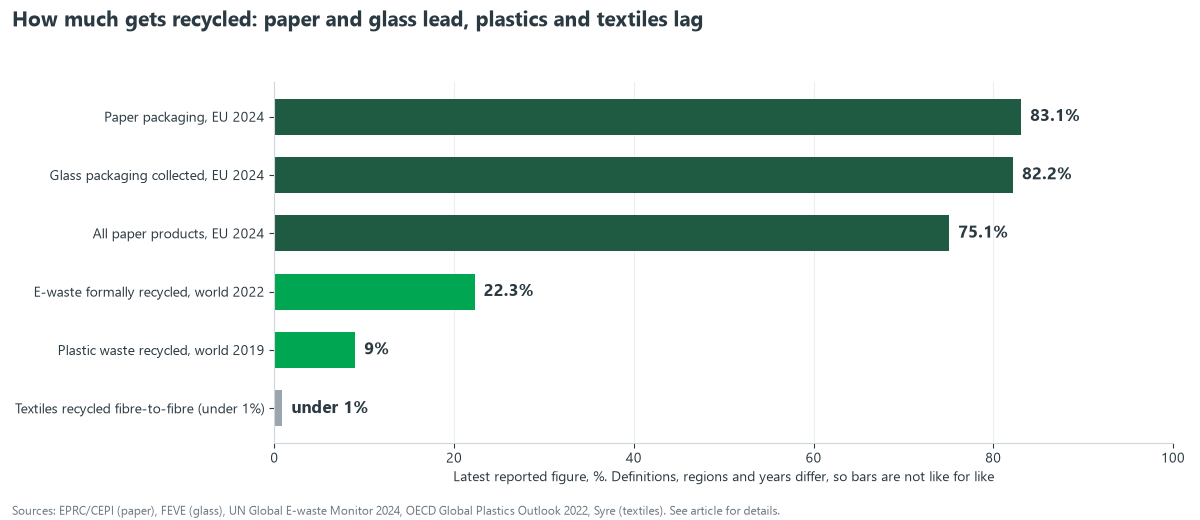
The pattern is clear. Materials with a simple, valuable, uniform stream and a ready industrial buyer, steel, aluminium, paper and glass, are recycled at scale. Materials that are mixed, contaminated or cheap to replace, plastics and textiles, are not. E-waste sits in between: the metals inside are valuable, but collecting and separating it is hard.
What recyclers actually make
Recycling is a manufacturing business, and what a recycler sells is a product with a specification.
| Material | What recyclers produce | Who buys it |
|---|---|---|
| Steel | Billets, rebar, sections and coil from scrap-fed electric arc furnaces | Construction, manufacturing |
| Aluminium | Remelted billet, ingot and sheet. Hydro's CIRCAL line, for example, contains at least 75% post-consumer scrap and is verified by DNV | Automotive, beverage packaging, building products |
| Copper | Cathode, anode and rod from smelters and refiners that take scrap, such as Aurubis and Umicore | Wire, cable, electrical and construction industries |
| Precious and other metals | Gold, silver, palladium and copper recovered from electronic scrap | Electronics, jewellery, investment markets |
| Batteries | Black mass and recovered metals. Ascend Elements produced recycled lithium carbonate at commercial scale for the first time in September 2025 | Cathode and cell makers |
| Plastics | Recycled PET flake and pellet, other polymer pellet | Bottle makers, packaging, fibres |
| Paper | Recycled pulp and board | Packaging and paper mills |
| Glass | Cullet, melted into new containers | Glass makers |
| Textiles | Recycled fibre and pulp. Circulose makes a pulp entirely from discarded cotton textiles | Fashion and fibre makers |
Sources: company and trade reports as cited in the sections below.
How customers are reacting
The evidence points to a consistent rule: demand for recycled products is strong where a large buyer, a law or a certified claim backs it, and weak where recycled costs more than new and nobody requires it.
Big manufacturers are committing
- Apple. Its 2026 Environmental Progress Report, covering products shipped in 2025, says a record 30% of the material in its products came from recycled content, up from 24% a year earlier. It says all Apple-designed batteries use 100% recycled cobalt, all magnets use 100% recycled rare earth elements, and all printed circuit boards use 100% recycled gold plating and tin soldering [11].
- Carmakers and recycled aluminium. Hydro will supply CIRCAL recycled aluminium for the front bumper system of General Motors' Cadillac Optiq, made at its Cassopolis, Michigan plant. Mercedes-Benz is set to be the first automaker in Europe to use CIRCAL in series production, for its next-generation large electric vehicles, according to an August 2026 report, and delivered an earlier 600 kg of extruded components to a Mercedes-Benz Trucks project in April 2026 [12].
- Novelis. The aluminium recycler targets raising its average recycled content to 75% by 2030 from a 63% baseline in fiscal 2024. In an earlier interview its CFO said automotive customers showed willingness, selectively, to discuss passing through a premium for low-carbon aluminium, tied to a carbon intensity of about 4 tonnes of CO2e per tonne or lower [13].
Consumers say yes, modestly
Surveys show consumers favour recycled content, though stated willingness to pay is modest and price still comes first. An Amcor study of 2,041 nut buyers in Germany, the Netherlands, Spain and the UK found 62% more likely to buy products in recyclable packaging and 60% more likely to buy with recycled content, with 62% willing to pay at least 3% more for recyclable packaging. Price and taste remained the top drivers [14]. A UK survey of homeowners for window maker Deceuninck found 68% would choose windows and doors with higher recycled content, but only 35% of older buyers said they would pay more [14]. Both are brand-commissioned surveys, and what people say they will pay is not the same as what they do.
Where customers say no: plastics
In Europe, recycled plastic is struggling against cheap new plastic. OPIS says buyers are unwilling to pay premiums while virgin plastic is cheap and expects demand to stay roughly flat in 2026, with mandated recycled-content targets sustaining demand only for the highest grades [15]. ICIS data cited by Packaging Europe counted 22 recycling sites that closed or announced closure in 2024 and 2025 [15]. Platts data cited by S&P Global put the premium of food-grade recycled PET over virgin at US$566 a tonne at the start of 2025, US$836 in early October and US$723 at the start of December, which shows that where law requires recycled content, buyers pay up [15]. The EU's Packaging and Packaging Waste Regulation becomes legally binding in August 2026, and Packaging Europe estimates the contact-sensitive recycled PET requirement at about 1.5 million tonnes a year by 2030, with a warning that domestic mechanical recycling capacity may not meet 2040 targets [15].
Fashion is signing partnerships
Textile-to-textile recycler Syre expanded its collaboration with Target in May 2026, and Circulose, which plans to resume production in the fourth quarter of 2026, signed a partnership with Birla Cellulose and became a scaling partner with Marks & Spencer [10]. These are early commitments in a market where recycled fibre is under 1% of supply.
Five innovation trends
1. Verified, low-carbon recycled metal
Recycled aluminium with third-party verification of its recycled content and carbon footprint is becoming a product category. Hydro reports a CIRCAL footprint of 1.5 kg CO2e per kg of aluminium or lower, an estimated 70% below the North American primary average, though that figure comes from a trade report and should be checked against the company's own data [12]. The point for sellers is that provenance and documentation now carry commercial value.
2. Closed loops with the manufacturers themselves
GM's partnership with Redwood Materials, under which Redwood recycles production scrap from GM facilities in Ohio and Tennessee, is an example of manufacturers locking recycling into their own supply chains [16].
3. A battery-recycling shake-out
Battery recycling attracted large investment, then ran into falling battery and component prices from China, which cut the value of recovered materials. Li-Cycle went into bankruptcy and its assets, including four North American spoke facilities and a plant in Magdeburg, Germany, were bought by Glencore for about US$40 million in a deal completed in August 2025, and renamed Glencore Battery Recycling [16]. Redwood launched Redwood Energy in June 2025 to reuse second-life packs for stationary storage [16]. The lesson is that recycling economics depend on commodity prices as much as on technology.
4. Textile-to-textile recycling
Five recyclers, Circ, Circulose, RE&UP, Samsara Eco and Syre, formed the T2T Alliance and proposed mandatory recycled-content targets of 10% by 2028, 15% by 2030 and 30% by 2035 [10]. These are proposals, not law, but they signal where the industry wants regulation to go.
5. Advanced plastics recycling and AI sorting
TotalEnergies started production in March 2026 at Grandpuits in France, a 15,000 tonne a year pyrolysis plant using Plastic Energy's technology, and now owns it outright. Other plants are planned: Petronas Chemicals' 33,000 tonne a year site in Malaysia was targeted for the first half of 2026, Ineos and Recuro have an agreement for a plant in Norway, WPU plans 80,000 tonnes in Rotterdam and Xycle, backed by Dow, expects to be fully operational by the fourth quarter of 2026 [17]. We could not confirm that all have started. On the sorting side, AMP Robotics reported a fleet of about 275 robots in more than 100 centres in an undated report, and agreed in November 2024 to equip a Waste Connections plant in Colorado designed for up to 62,000 tons a year of single-stream recycling, slated for early 2026 though we could not confirm its commissioning [18].
Companies worth watching
| Company | What it does | Recent signal | Source |
|---|---|---|---|
| Apple | Consumer electronics maker | 30% recycled content across 2025 products, with 100% recycled cobalt in its batteries | [11] |
| Hydro | Aluminium producer and recycler | CIRCAL supplied to GM and Mercedes-Benz | [12] |
| Novelis | Aluminium rolling and recycling | Targets 75% average recycled content by 2030 | [13] |
| Aurubis | Copper smelter and recycler | Raised fiscal 2025/26 outlook to EUR 425 to 525 million operating earnings before tax, helped by precious metal prices, while flagging low treatment charges and tight feedstock | [19] |
| Umicore | Materials technology and recycling | Described a very strong recycling business in its first-quarter 2026 update | [19] |
| Glencore Battery Recycling | Ex-Li-Cycle battery recycling | Acquired for about US$40 million, completed August 2025 | [16] |
| Redwood Materials | Battery recycling and materials | Recycling GM production scrap, launched Redwood Energy | [16] |
| Ascend Elements | Battery materials recycler | First commercial-scale recycled lithium carbonate, September 2025 | [16] |
| Circulose and Syre | Textile-to-textile recyclers | Partnerships with Marks & Spencer, Birla Cellulose and Target | [10] |
| TotalEnergies | Energy and chemicals | Started a 15,000 tonne a year advanced plastics recycling plant in France in March 2026 | [17] |
| AMP Robotics | AI sorting for recycling plants | Fleet of about 275 robots reported in an undated source | [18] |
This is not a ranking or a recommendation. It names companies that appear repeatedly in 2026 reporting, and we found conflicting or incomplete information on several, so check current company releases before relying on any item.
The headwinds
| Headwind | Evidence |
|---|---|
| Cheap new material | European recyclers continue to struggle against virgin plastics, with 22 sites closed or announced for closure over 2024 and 2025 [15] |
| Commodity-price exposure | US battery recyclers were hit by falling battery and component prices [16] |
| Scarce, tight feedstock | Aurubis flagged tight feedstock and pressure on treatment charges [19]. Scrap tightness is also a theme in copper. See Copper Prices: Analysis, Risks and Outlook |
| Scale of the problem | Only 22.3% of e-waste and about 9% of plastic waste is recycled [8][9] |
| Contamination and quality | Contaminant elements limit scrap-based steel quality, according to one market report [20] |
What this means for scrap sellers and buyers
Recycled products only exist because someone supplies clean, documented scrap. That is where ScrapTrade's users sit in the chain. Three practical points follow:
- Grade and documentation increase value. Verified recycled content is a premium product, which rewards clean sorting and clear records. See how to grade scrap metal.
- The metals have different economics. Read the guides to copper, aluminium, steel and e-waste for grades, prices and demand.
- Rules and mandates shape demand. Recycled-content laws, scrap-export restrictions and tariffs change where material goes. See Europe Is Keeping Its Scrap. Who Pays?.
To sell material, check the live prices for an indicative reference and list it on the marketplace.
Frequently asked questions
What is the most recycled material in the world?
By weight, steel: world steelmakers use about 630 million tonnes of scrap a year. By rate, paper packaging and glass packaging are recycled or collected at more than 80% in the EU.
What do recyclers make from scrap?
Metal producers make billets, cathode, ingot and sheet. Others make recycled pulp, glass cullet, plastic flake and pellet, black mass from batteries and recycled textile pulp.
Are customers willing to pay for recycled products?
Large manufacturers are committing, and consumers say they favour recycled content, but stated willingness to pay is modest. Demand is firmest where law or large contracts require it.
Which recycling sectors are struggling?
European plastics recycling, where cheap virgin material has forced closures, and US battery recycling, hit by falling component prices.
What is the fastest-growing recycling trend?
Verified recycled content in metals and consumer products, closed-loop partnerships with manufacturers, and mandated targets in packaging and, potentially, textiles.
Sources
- EUWID, Scrap use in global steel production rises in 2025 (June 2026).
- GMK Center, The share of EAF in global steel production in 2024 increased to 29.1%.
- Australian Aluminium Council and L.E.K. Consulting, Enabling Development of Aluminium Recycling Capability in Australia (March 2026).
- AL Circle, Recycled aluminium outlook. Trade-press estimates differ by source.
- Recycling Today, Copper recycling secondary output 2023 rising, citing the International Copper Study Group.
- European Paper Recycling Council via CEPI, European Paper Recycling Council reports strong recycling rates for 2024.
- FEVE, Glass collection for recycling rate and 2024 update.
- UNITAR, Global E-waste Monitor 2024.
- OECD, Global Plastics Outlook (2022), as reported by Circular Online.
- FashionUnited, Textile-to-textile recyclers form new T2T Alliance; Fiber Journal, Investments cue optimism for circular textiles that can scale.
- Apple, Apple accelerates progress with highest-ever recycled material in its products (April 2026).
- Hydro, Hydro brings high-recycled aluminium to General Motors EV with Hydro CIRCAL; Engineering News, Vehicle manufacturer turns to recycled aluminium for greener future (August 2026).
- Novelis, Form 10-K, fiscal 2026; Fastmarkets, Automakers increasingly interested in green aluminium: Novelis.
- Packnode, Amcor study shows recyclable packaging drives nut purchases (undated); Deceuninck and YouGov UK survey as reported by Glass Times.
- OPIS, 2026 outlook: policy and economics to shape European recycled plastics; Packaging Europe, How the EU's PET market fares through war, law, costs and more; S&P Global, Recycled polymers.
- Project Blue, US Li-ion recycling: recent developments under policy shifts and price swings; Energy-Storage.news, US battery recycling in doldrums; EV Magazine, Top 10 battery recycling companies. Some company details are from single secondary sources.
- Hydrocarbon Processing, TotalEnergies starts production at France's first advanced plastics recycling plant; ChemEngOnline, Petronas Chemicals to build Asia's largest advanced recycling plant; Port of Rotterdam, WPU plans chemical recycling plant.
- Business Wire, AMP to operate Waste Connections recycling facility with AI-powered sortation technology (November 2024); TechCrunch, AMP Robotics profile.
- Resource Recycling, Aurubis sends positive signal for metals recovery markets and Metals and electronics recyclers report growth (May 2026).
- Research and Markets, Global green steel market 2026 to 2036.
Figures are as reported by the sources named and change quickly. Several are from secondary or undated sources, as noted, and some company developments could not be confirmed. This article is general information, not investment advice. ScrapTrade operates a scrap marketplace and has a commercial interest in recycling and the scrap trade.