

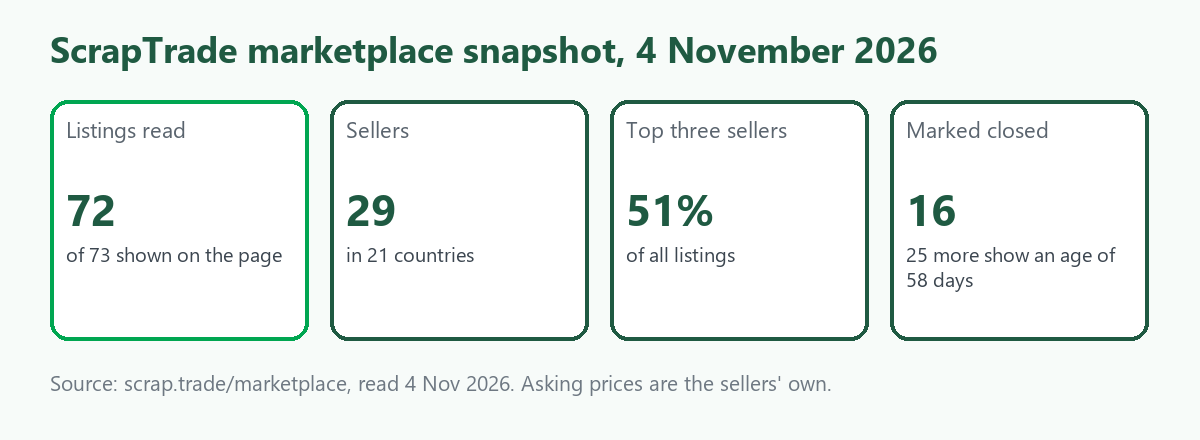
ScrapTrade is a marketplace, so the best way to see what is for sale is to look. We did, and counted. On 4 November 2026 the marketplace page showed 73 listings, and we read 72 of them. This post sets out what is listed, where it is, how it is offered, and how the asking prices compare with the world benchmark. It is a snapshot, not a catalogue: listings are written by sellers, ScrapTrade does not set or guarantee their prices or quantities, and some listings are old or closed. We use the numbers to show how to read a listing, which is what you need before you contact a seller. We have a commercial interest in the scrap trade.
What is listed
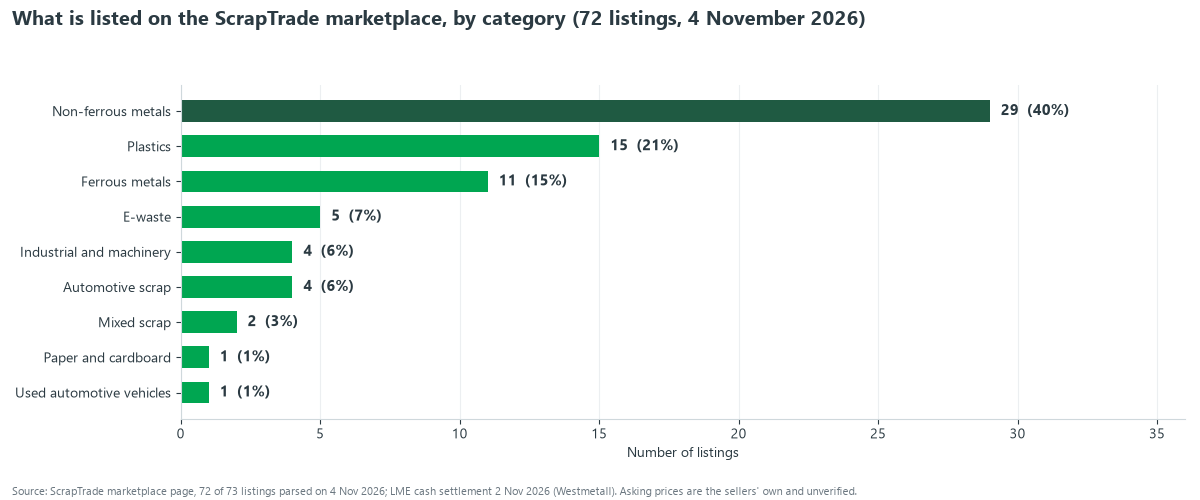
| Category | Listings | Share |
|---|---|---|
| Non-ferrous metals | 29 | 40% |
| Plastics | 15 | 21% |
| Ferrous metals | 11 | 15% |
| E-waste | 5 | 7% |
| Industrial and machinery | 4 | 6% |
| Automotive scrap | 4 | 6% |
| Mixed scrap | 2 | 3% |
| Paper and cardboard | 1 | 1% |
| Used automotive vehicles | 1 | 1% |
Non-ferrous metal is the biggest group. It includes aluminium cans (UBC), wheels, wire, extrusions and radiators, copper wire and pipe, and zinc die cast. Plastics are mostly film, bottles, foam and bales. Ferrous listings include cast iron, heavy melting steel (HMS), steel plate and rails. See Scrap Metal Types and Grades for what the grade names mean, and our glossary in seven languages for the terms.
Where it is, and who is listing it
The 72 listings come from 29 sellers in 21 countries. The United Kingdom has 23 listings, the United States 12, Australia and Kenya 6 each, Egypt and Saudi Arabia 3 each, and Indonesia, Tanzania, Malaysia and Singapore 2 each, with eleven more countries at one. The listings are concentrated: three sellers account for 37 of the 72 (51%), and one of them has 20. That matters if you are judging how deep the market is. A page of 72 listings is a long list from a small number of sellers, not 72 independent offers.
How it is offered
Prices are in US dollars. Listings are quoted FOB in 42 cases, EXW in 29 and DDP in one, and 57 are priced per metric tonne, with five per ton, four per kilogram, three per container, two per pallet and one per piece. Where a condition is shown, 28 listings say Clean and 16 say Mixed, and 25 show no condition. Two are marked as auctions. If you are new to the terms, read Incoterms in Scrap Deals: FOB means the seller loads the goods onto the ship at the named port, and EXW means you collect from the seller's premises.
The listings are also not all fresh. Twenty were posted in the last 14 days, 27 between 15 and 40 days ago, and 25 show an age of 58 days. Sixteen are marked Closed. Look at the age and status before you spend time on a listing.
The same material, asked at very different prices
Asking prices are set by sellers, and the spread for one material can be wide. The London Metal Exchange (LME) price is the reference for refined metal, and scrap normally sells below it, because of grade, contamination and processing. On 2 November LME cash was US$3,095 a tonne for aluminium and US$14,380 for copper. Here is how the listed prices compared, rounded as the site shows them.
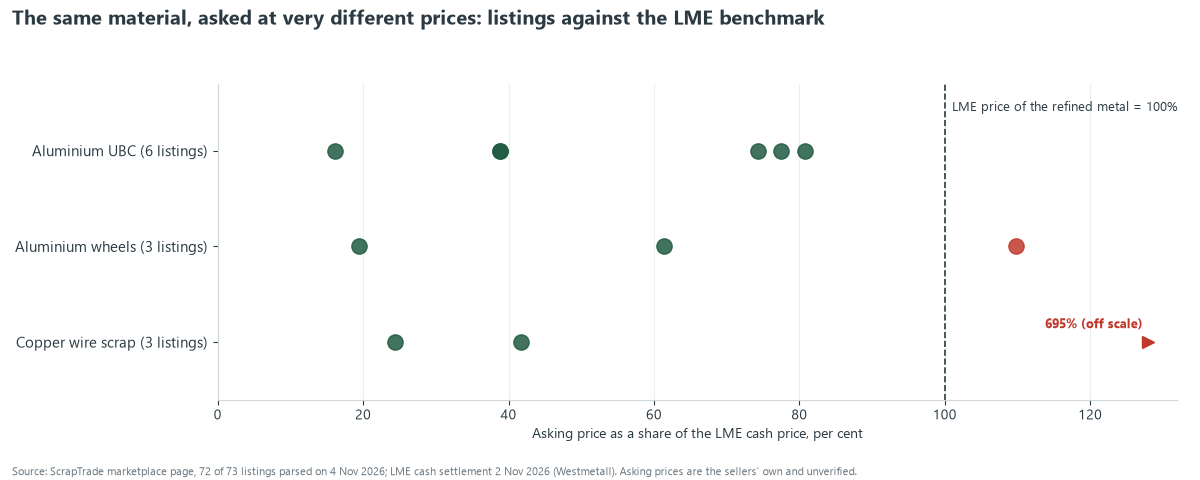
| Material | Asking prices, US$ a tonne | Share of the LME price |
|---|---|---|
| Aluminium UBC (6 listings) | 500, 1,200, 1,200, 2,300, 2,400, 2,500 | 16% to 81% |
| Aluminium wheels (3 listings) | 600, 1,900, 3,400 | 19% to 110% |
| Copper wire scrap (3 listings) | 3,500, 6,000, and one at US$100 a kilogram | 24%, 42% and about 695% |
What this shows:
- Aluminium cans are asked at prices five times apart. Some of the spread is real, since a clean baled load, a mixed load and a load in a distant port are worth different amounts. But a gap of that size is a reason to ask what exactly is being sold.
- A price above the LME price of the refined metal is a warning. Scrap does not normally sell above it. A wheel listing at 110% is probably an error or a different product.
- A unit mix-up is easy to make. The copper wire listing priced at US$100 a kilogram is US$100,000 a tonne, almost seven times the LME copper price. It is almost certainly a price or unit slip, and a buyer should not take it at face value.
- A very low price is not a bargain until you know the grade. A listing at 16% or 24% of the benchmark may be a different grade or an error, or it may be the start of a scam, so check it first.
Five checks before you contact a seller
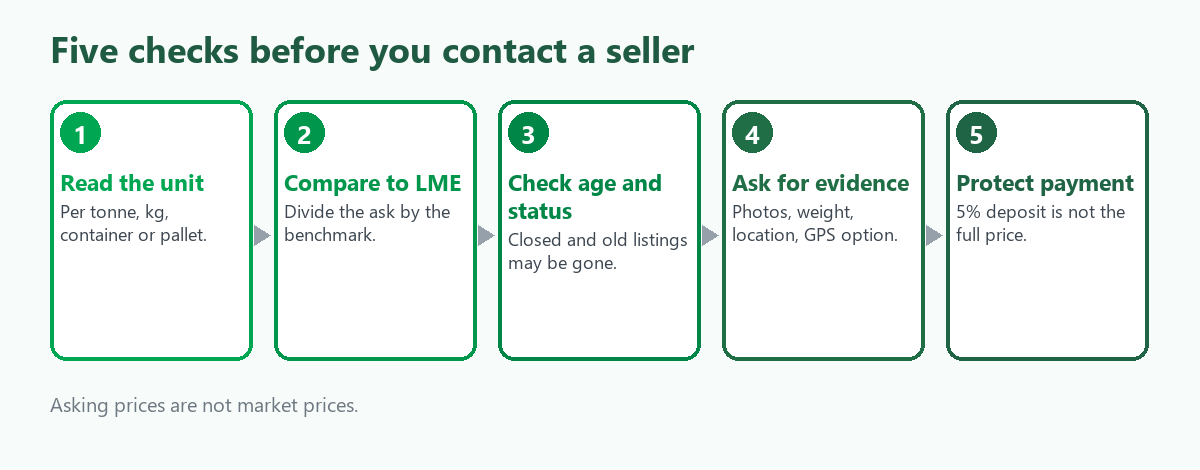
- Read the unit. Per tonne, per ton, per kilogram, per container and per pallet are different. Convert to one unit with Convert Metal Prices to Your Currency per Kg.
- Compare with the benchmark. Divide the asking price by the LME price and note the ratio. See Buying Copper and Aluminium Scrap in Australia and Scrap Metal Prices in India for how.
- Check the age and status. Closed and very old listings are often not available.
- Ask for evidence. Photos, a weight, a location and, where the seller has added one, a GPS-verified listing. A quantity that looks too big for the seller, or a purity claim with nothing to back it, deserves a question. Our guide, How to Verify Scrap Before You Buy or Sell, goes through it.
- Protect payment. ScrapTrade's pages say the buyer pays a 5% deposit that is held in escrow to hold the buyer to the trade. That is not the full price and does not cover the condition of the material, so agree how the rest is paid and inspect before you release it. See How to Secure Scrap Deals and Avoid Scams.
If you want to buy or sell
If you are buying, browse the marketplace, compare listings against the benchmark, and use a buyer request to say what you want. If you are selling, list your scrap with a clear grade, weight, location and photos, and price it from the benchmark and not from the highest ask you can find. You can create a free account to do either.
What we could not verify
- That any listing is accurate. We read what is shown on the page. We have not verified quantities, grades, purity claims or sellers.
- The 73rd listing. The page said 73 listings and we parsed 72.
- What the age figure means. Twenty-five listings show 58 days, and we do not know why they share it.
- How much of the benchmark gap is real. The LME price is for refined metal, and scrap is sold at a discount of unknown size.
- Prices from other days. The LME figures are from 2 November 2026 and the listings from 4 November.
Frequently asked questions
What can I buy on ScrapTrade?
On 4 November 2026 the marketplace showed listings in nine categories, mostly non-ferrous metals, plastics and ferrous metals, from 29 sellers in 21 countries.
Are the listed prices market prices?
No. They are the sellers' asking prices, and ScrapTrade does not set or guarantee them. Compare any price with the benchmark and ask what grade it is for.
What is the difference between FOB and EXW?
Under FOB the seller loads the goods onto the ship at the named port. Under EXW you collect from the seller's premises.
How do I know a listing is real?
Check the age and status, ask for photos, weight and location, compare the price with the benchmark, and agree how payment and inspection will work before you commit.
Sources
- ScrapTrade marketplace page, scrap.trade/marketplace, read on 4 November 2026 (72 of 73 listings).
- London Metal Exchange official prices, 2 November 2026, as published by Westmetall.
Listings are written by sellers and are not verified by ScrapTrade for this article. This is general information, not financial advice. ScrapTrade operates a scrap marketplace and has a commercial interest in the scrap trade.