

Read enough scrap news and the same few names keep turning up. "BIR says". "ReMA welcomed". "The Basel Action Network warned". They are quoted as if they were all the same kind of body. They are not. Some are trade associations that exist to promote and protect the people who buy and sell scrap. One is a campaign group that wants stricter limits on the waste trade. None of them sets prices, and none of them is a regulator. Knowing which is which changes how you read what they say.
This is a guide to the main ones, built from each body's own description of itself where we could read it. Where we could not confirm something, we say so. It is general information, not an endorsement of any group, and ScrapTrade has a commercial interest in the scrap trade.
First, three kinds of body
| Kind | What it does | Examples in this article |
|---|---|---|
| Trade association | Represents the businesses that buy, process and sell scrap; lobbies governments; sets or maintains trading norms; runs events | BIR, ReMA, BMRA, EuRIC, MRAI |
| Peak body for a wider sector | Represents waste and resource recovery as a whole, of which metals are one part | WMRR in Australia |
| Campaign group | Pushes for tighter rules on what is traded and where | Basel Action Network |
A trade association speaks for its members' commercial interests. That does not make it wrong, and its statistics are often the best available. It does mean its policy positions come from one side of the table. A campaign group speaks from another side. Neither is a neutral referee, and reading both is how you see the whole argument.
The global federation: BIR
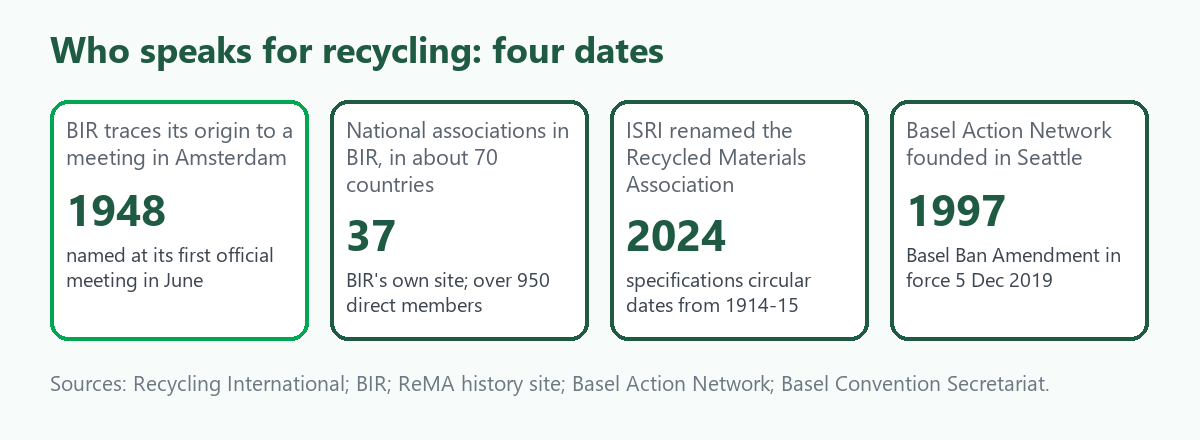
The Bureau of International Recycling (BIR) calls itself the only global recycling industry federation, and is based in Brussels. Its own site says it represents more than 30,000 companies worldwide, through over 950 direct members and 37 national associations across 70 countries [1].
History. Recycling International's account of BIR's 75th anniversary says leading recyclers from the Benelux countries met in Amsterdam on 18 March 1948, and the group was officially named the Bureau International de la Récupération at its first official meeting that June [2]. Membership figures in older and newer sources differ, so use the current figures on BIR's site rather than a number from an old article.
Structure. BIR is organised into commodity divisions: Ferrous Metals, Non-Ferrous Metals, Paper, Textiles, Stainless Steel and Alloys, Plastics, Tyres and Rubber, and Electronics [1]. For a scrap trader the first three are the ones that matter most.
What it publishes. BIR's site lists market statistics, position papers, a magazine called The Recyclist, and twice-yearly World Recycling Conventions, with the 2026 edition in Malaga in late October [1]. Its statistics are worth knowing. The figures in Steelmakers That Melt Scrap, Not Trade It, on how much recycled steel the world's mills use, came from BIR's World Steel Recycling in Figures as reported by SteelOrbis.
How to read it. BIR argues for open trade in recyclable materials, and opposes measures that would limit exports. When BIR comments on a new export rule, that is the lens.
The United States: ReMA (formerly ISRI)
The Recycled Materials Association (ReMA) is the US trade association. Its history page traces a line of predecessors from the National Association of Waste Material Dealers, formed in Boston in 1913, and the Institute of Scrap Iron and Steel, formed by about 20 ferrous recyclers in New York in 1928. The two lines merged in 1987 to become the Institute of Scrap Recycling Industries (ISRI), which was renamed ReMA in 2024 [3].
The specifications circular. This is the part of ReMA most scrap buyers meet without knowing it. Its history page says the first industry specifications, now the ISRI Specifications Circular, were published in 1914 to 1915, and that the circular still guides the buying and selling of processed scrap [3]. When a quote says "ISRI 200-206" or a contract says "to ISRI specification", it is pointing at this document. The Dubai Municipality guideline we covered in Scrap Business Rules in Dubai: The Guidelines cites ISRI specifications as an example of a grading standard, which shows how far the circular travels outside the United States.
Advocacy. ReMA's work is visible in the US copper story. Recycling International reported that ReMA claimed success in persuading the White House that export restrictions on high-quality copper scrap were not warranted [4]. The details of what was and was not decided are in US Copper and Critical-Mineral Scrap Policy.
Size. A ReMA notice from around 2024 describes the association as representing approximately 1,300 companies [5]. Other sources give higher facility counts, which probably measure something different, so treat any single number carefully.
The United Kingdom: BMRA
The British Metals Recycling Association (BMRA) describes itself as run by members, for members. Its site says it has about 300 member organisations, including metal recyclers in the UK and abroad and businesses that serve the industry. Recycling companies must be in good standing and have traded for at least two years, and all members must follow its Code of Conduct [6].
Its five stated objectives are to be an effective voice for the UK metals recycling industry, to promote the sector, to influence European and UK legislation, to help members respond to market and regulatory changes, and to provide services that benefit members [6]. BMRA's site also gives industry figures: a UK metal recycling sector worth £7 billion, about 2,000 businesses, about 15,000 employees and roughly 11.6 million tonnes of ferrous and non-ferrous metal handled a year [6]. These are the association's own figures and we have not checked them independently.
Europe: EuRIC
The European Recycling Industries' Confederation, known as EuRIC, was formed in 2014 by three existing groups: the European Ferrous Recovery and Recycling Federation, the European Recovered Paper Association and EUROMETREC, the non-ferrous metals branch [7]. It works through national member federations, and one source reports that BMRA is a member and that a Middle East association has joined as its first non-European member [7]. Our sources describe the metals work as split between a ferrous branch and a non-ferrous branch. We found hints that the confederation has been renamed Recycling Europe but could not confirm it, so check its current website for the name and member count.
EuRIC matters to anyone selling into or through Europe because it is a main voice on the rules we describe in EU Scrap Exports: Volumes, Rules and Duties. It has said it supports smarter oversight of recycled metals but cautions against rushed trade measures [7].
India: MRAI
The Material Recycling Association of India (MRAI) was formerly the Metal Recycling Association of India. Reports say it was founded in 2011, with a first meeting attended by representatives of about 40 companies and several associations, and that it later broadened its scope from metals to other scrap such as plastic, paper, e-waste and tyres [8]. Reported membership has varied from over 500 individual members and regional associations representing over 7,000 companies in 2016 to over 1,200 members in a 2022 budget submission [8]. These figures come from different years and descriptions, so treat them as indicative.
MRAI is the body behind the lobbying on import duties that we covered in India's Scrap Market: Imports, Duties and Rules. Metal.com has reported MRAI seeking removal of duty on ferrous and non-ferrous scrap imports [9].
Australia: WMRR and the gap we could not fill
The Waste Management and Resource Recovery Association of Australia (WMRR) calls itself the national peak body for the waste and resource recovery sector. Its site says it lobbies governments, links members through national divisions, state branches and working groups, and provides training, data and policy analysis [10]. Its 2026 flyer says it has represented the sector since 1992 [10]. Its homepage, as we read it, does not mention metals or scrap specifically, so it is a broad sector body rather than a scrap-metal one.
Some Australian scrap businesses state that they are members of a metal-specific body called the Australian Metal Recycling Industry Association (AMRIA). We could not find an official AMRIA website, a membership list or a published code of conduct, and the name appears slightly differently in different places. We therefore say nothing more about it. If you are an Australian operator and want to know whether a buyer belongs to a body with a code of conduct, ask the buyer for the membership details and check them with the body directly.
The campaigner: Basel Action Network
The Basel Action Network (BAN) is a different kind of organisation. It describes itself as a non-profit based in Seattle, with a mission to champion global environmental health and justice, and focuses on electronic waste and old ships [11]. Reports credit Jim Puckett, its executive director, with founding it in 1997. It is named after the Basel Convention, the 1989 UN treaty on hazardous waste, and its programmes include Basel advocacy, a plastic waste transparency project, green ship recycling and e-Stewards, a certification standard for electronics recyclers that it created and manages [11].
Why it matters for scrap. BAN's central cause is the Basel Ban Amendment. The Basel Convention Secretariat says it took effect on 5 December 2019, and prohibits the export of hazardous waste from developed countries, the EU, the OECD and Liechtenstein, to other countries [12]. A law-firm analysis notes that the United States is not a party to the Basel Convention and that the EU had already implemented the ban in its own shipment rules [13]. BAN's interest is in making sure exports of electronics and other hazardous waste do not end up in places that cannot manage them. See Dangerous Items in Scrap and What to Refuse.
How to read it. BAN is not a trade body. It pushes for stricter limits and for exposing illegal shipments. Its aims overlap with the trade bodies' on some issues, such as stopping illegal dumping, and conflict on others, such as how tightly to restrict exports of recyclables.
Which body for which question
| If you want to know | Look first at |
|---|---|
| How a grade is defined in a US-style contract | ReMA's Specifications Circular |
| Global mill consumption and trade statistics | BIR's market statistics |
| What the EU is doing on scrap exports | EuRIC |
| UK rules and industry figures | BMRA |
| Indian import duty lobbying | MRAI |
| Australian waste policy | WMRR, then the relevant government department |
| Whether hazardous exports are restricted | The Basel Convention Secretariat, with BAN as the campaigner's view |
What none of them do
- They do not set prices. Prices come from trade and from price reporting agencies. See How Scrap Prices Are Set: Benchmarks Explained.
- They do not regulate. Governments make the rules. Associations argue about them.
- They do not guarantee a member. Membership of a body with a code of conduct is a signal, not a guarantee. Verify your counterparty yourself. See How to Verify Scrap Before You Buy or Sell.
- They do not give you a licence. Rules for starting out differ by country. See Scrap Business Rules and Documents by Country.
A scenario: reading a headline
You read: "Recycling industry welcomes decision not to restrict scrap exports." Three questions help.
- Who said it? If it is a trade association, "the industry welcomes" means its members' commercial interest is served.
- What exactly was decided? A body can welcome a decision that is narrower than the headline. The US copper story shows how a proposal, an order and an implementation can be three different things.
- What would the other side say? A campaign group may read the same decision as a loss.
Then check the primary source. In the US case, that was the proclamation text itself. (An invented example of a habit, not a real news item.)
What this means for you
- Use associations for statistics and standards, and read their positions as positions.
- Join the one in your country if it fits. We have not assessed any membership offer, and fees and benefits are theirs to state.
- Ask counterparties about membership and codes of conduct, then verify.
- Follow the primary documents. The treaty, the proclamation, the guideline. Associations summarise.
To compare buyers and list material, see the ScrapTrade marketplace or register.
Frequently asked questions
What is the Bureau of International Recycling?
BIR is a Brussels-based federation that calls itself the only global recycling industry federation. It reports over 950 direct members and 37 national associations across 70 countries, with divisions for ferrous metals, non-ferrous metals and other materials [1].
What is the ISRI specification?
It is the Specifications Circular published by what is now the Recycled Materials Association. Its first edition dates from 1914 to 1915, and it is still used to describe processed scrap grades [3].
Is ISRI the same as ReMA?
Yes. The Institute of Scrap Recycling Industries was renamed the Recycled Materials Association in 2024 [3].
Does the Basel Action Network represent recyclers?
No. It is a campaign group that focuses on electronic waste, plastics and ships, and also certifies electronics recyclers under its e-Stewards standard [11].
Is there an Australian association for scrap metal?
WMRR is the national peak body for waste and resource recovery [10]. Some scrap businesses say they belong to AMRIA, but we could not verify its details.
Sources
- Bureau of International Recycling, BIR homepage, as read in October 2026.
- Recycling International, BIR returns to its roots for 75th anniversary.
- Recycled Materials Association, Celebrate ReMA's history.
- Recycling International, No export controls for US copper scrap (4 August 2025).
- Recycled Materials Association, notice on scrap specifications (c. 2024), as summarised in search results.
- British Metals Recycling Association, About BMRA.
- Recycling Today, European recycling group formed, and BMRA news items on EuRIC elections, as summarised in search results.
- Recycling International and Recycling Today reports on MRAI, as summarised in search results.
- SMM, MRAI seeks removal of duty on ferrous and non-ferrous scrap imports.
- WMRR, wmrr.asn.au and 2026 membership flyer.
- Basel Action Network, What we do.
- Basel Convention Secretariat, Entry into force of amendment to UN treaty boosts efforts to prevent waste dumping (13 September 2019).
- Beveridge & Diamond, Basel Ban Amendment to Restrict International Trade in Hazardous Recyclables.
Descriptions are taken from each body's own pages or from the reports cited, and membership numbers change. The scenario is invented. This article is general information, not an endorsement of any organisation or advice on joining one. ScrapTrade operates a scrap marketplace and has a commercial interest in the scrap trade.